


Sintered filters are produced through a sintering process, where materials such as metal powders, ceramic, or polymer fibers are subjected to heat and pressure, bonding them into a solid, homogeneous structure. These materials are typically formed into tubular shapes via molding or isostatic pressing, often eliminating the need for cores. This method imparts several advantages to sintered filter elements, including:
High Mechanical Resistance: Sintered filters have a robust structure and exceptional durability, making them suitable for harsh operating conditions.
High Chemical Resistance: When made from appropriate materials, these filters resist a wide range of chemicals and perform well in corrosive environments, effectively handling abrasive particles like catalysts.
Precise Filtering Capability: The porous structure allows for the separation of very fine particles, crucial for fluid purification.
Cleanability and Reusability: Many sintered filters can be washed and reused, resulting in lower operating costs.
Sintered elements find applications across various industries, including oil, gas, and petrochemicals, with materials chosen based on operating conditions and cost considerations.
Metal-sintered filters have extensive applications across numerous industries. In oil, gas, and electricity sectors, they are utilized in several processes. For instance, in the Fluid Catalytic Cracking (FCC) process, these filters recover catalytic particles from streams and purify fluids like slurry oil, a byproduct of the FCC unit. When made from alloys such as stainless steel, they can be employed in desalination processes to prevent corrosion in oil, gas, and petrochemical industries. Additionally, these filters are used in compressed air filtration, polymer filtration, and the chemical industry for the purification and separation of acids and solvents. Their applications extend to sectors like the automotive, pharmaceutical, and food industries.
Sintered filters can be produced from various materials, selected based on the specific application and operating conditions. Materials include metals, ceramics, polymers, and composites, which undergo the sintering process in forms such as powders, fibers, or wire meshes. The following section introduces the types of sintered filters and their mechanisms and functions.
The primary structure of these elements consists of metal particles. Depending on the pre-sintering shape, there are four main types of metal media: powders, fibers, woven meshes, and composites that combine different media, such as powder with mesh or multiple layers of mesh. This results in significant structural differences that influence properties like porosity, pore size distribution, permeability, and filtration efficiency.
Both powder and fiber media primarily operate through depth filtration, making them generally less easily cleaned than sintered meshes, which utilize surface filtration. Sintered metal filters provide more precise control over pore size, shape, and uniformity compared to plastic filters, resulting in a stronger, stiffer, and more heat-resistant matrix. The pore size in metal filter elements can range from sub-micrometer to 1 mm. They can be produced in three main forms: filter elements with metal powder (sintered powder metal), metal fibers (sintered metal fiber), and metal mesh (sintered wire mesh).
Theoretically, sintered powder metal elements can meet the demands of ultrafine filtration, but their very fine porosity leads to higher resistance to fluid flow. Porosity, defined as the ratio of void spaces to the total volume of the matrix, can be controlled across a wide range in sintered metal elements. While increased porosity decreases flow resistance, it can compromise the matrix’s strength. For optimal mechanical strength, it may be necessary to limit porosity. In filter elements, porosity can reach up to 70% or higher for low pressure drop applications. A key advantage of sintered metal filter elements is their superior strength compared to non-metallic media, making them particularly suitable for high-pressure applications.
Sintered metal powder filters can be categorized into two main types: those produced by sintering loose metal powder in a mold and those created through high-density processes. Both types utilize spherical particles as the starting material, as their uniformity leads to consistent pore sizes. The production and classification of these spherical particles are relatively straightforward, typically achieved through spray atomization and sieving.
Coarse filters are defined as sintered metal filters with a particle diameter of approximately 1 mm. Given that the pore size is usually about 15% of the particle diameter, this results in a pore size of around 150 µm. While the production of such porous metal filters can be costly, making them competitive with wire mesh at this scale, the costs associated with sintered metal filters decrease when using smaller particle diameters. However, as pore sizes decrease, the strength of the material may also diminish.
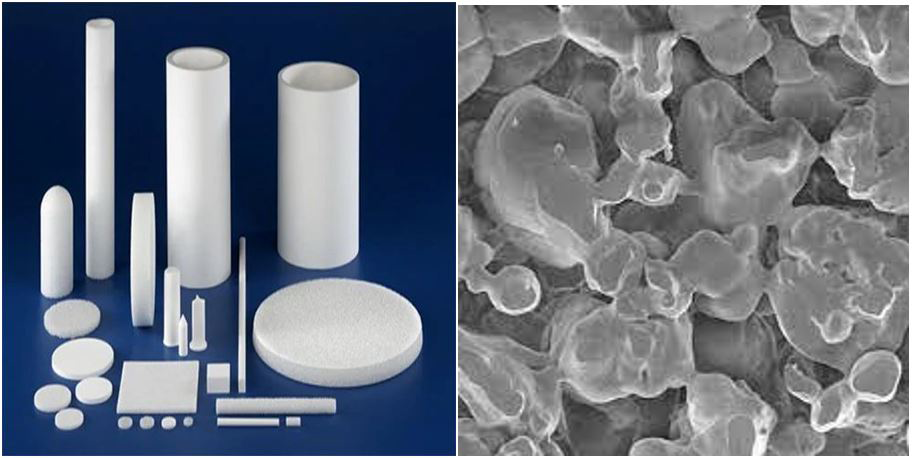
Figure 1 illustrates an example of a metal powder element filter, accompanied by a photo showcasing the structure of this type of element.

For most general applications, porous bronze filters are suitable. However, in scenarios involving high pressures, elevated temperatures, or corrosive fluids, filter elements may be sintered from materials such as stainless steel, Monel, pure nickel, Hastelloy, titanium, or even tungsten. Bronze, copper, and nickel can be easily sintered at low temperatures, allowing for the production of shapes directly from metal powder using stainless steel or carbon molds. The mold is then passed through a furnace in a protective environment to facilitate sintering.
Pressed or machined shapes may require further modifications to enhance surface porosity. While conventional molding methods are still prevalent, the introduction of isostatic pressing allows for a wider variety of shapes and sizes to be produced.
Porous stainless steel elements are ideal for applications demanding high strength, temperature resistance, and corrosion resistance. These elements are typically produced in the form of plates or discs, which are directly filtered to create the final product. The material commonly used is stainless steel equivalent to BS304S15, with a carbon content of 0.05%. Due to their greater surface area, porous metals can be more susceptible to damage than solid metals. The fine filtration offered by porous metal elements, combined with equipment that ensures precise grading, makes them highly desirable for heavy-duty and high-disturbance applications.
This type of filter not only provides the capacity to retain pollutants but can also be designed for automatic operation, potentially outperforming simpler devices. Basic cleaning may require ultrasonic and/or chemical methods.
Metal fiber filter media consist of very thin (1 to 80 µm) metal filaments that are uniformly arranged at their contact points, creating an irreversible three-dimensional structure. These media are specifically designed for surface or depth filtration and can be constructed in single or multi-layer formats. Notable forms include shredded fibers and needle felt. During use, fibers may become crushed.
Needle-felt structures consist of metallic fibers that are sintered to create a smooth and hard surface. Metal fibers can be produced from various alloys, including stainless steel, nickel, nickel alloys, and high-resistance alloys.
Metal fiber media are employed in air and liquid filtration applications requiring temperature and chemical resistance. They can be welded into filters with high structural integrity and are suitable for cleaning and reuse.
Sintered metal fiber media feature long fibers with controlled diameters, and one of their notable characteristics is their exceptionally high porosity, which is double that of ordinary media due to the powder structure. Additional advantages include significantly lower resistance to flow and higher storage capacity.

The density of the individual wires in the mesh significantly contributes to its stability, particularly regarding the apertures when subjected to movement or vibration during use. To enhance stability, a mesh sintering process can be employed, where the layers of wires are fused at their points of contact to form a cohesive fabric. Typically, the bottom layers of these filters feature coarse mesh for added strength, followed by one or two layers of fine mesh for effective filtration, capped with a coarser backing layer. The nominal rating for such media can reach up to 5 µm. Additionally, the sintering process can utilize finer wires, creating a higher porosity area that reduces flow resistance and increases dust-holding capacity. Sintered metal elements also offer the advantage of being cut and shaped without the risk of local disintegration, a capability not available with sintered muskets.
Sintering is particularly effective in maintaining the stability of multilayer meshes. Composite wire mesh structures, consisting of several layers of porous mesh, are designed to produce a high-strength, durable porous sheet that outperforms single-layer meshes. This multilayer structure facilitates depth filtration by enhancing the holding capacity of the medium. Wire meshes are typically sintered to create a uniform fabric and ensure the precision of the openings formed during weaving. While conventional mesh elements are pleated for surface filtration applications, sintered mesh cartridges are also employed in depth filters. Wire meshes can be laminated and subsequently sintered to produce a thick medium with specific variations in pore size.
The most recognized format for sintered wire mesh is the multilayered configuration, which allows the development of a surface filtration medium characterized by fine pores and exceptional mechanical strength. Several reputable companies offer a five-layer model under the brand name “plate,” but multilayer porous wire cloth can be customized to any number of layers as specified by the end user.
Sintered wire mesh is predominantly made from stainless steels, with 304L and 316L being the most common grades; however, other materials such as phosphor bronze and alloys like Hastelloy are also available.
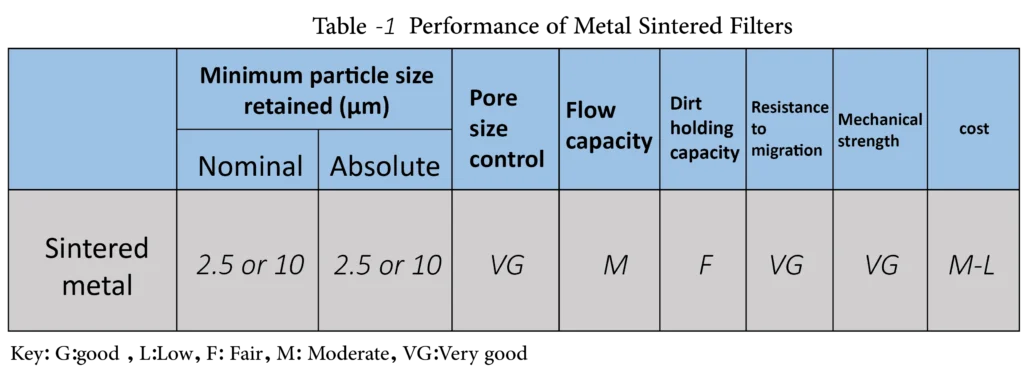
Various factors must be evaluated in the sintering process for specific applications. Table 1 presents the performance metrics of metal sintered filters. The relative performance of different media may vary based on the fluid’s characteristics and operating conditions, including the filtration rate. Three critical factors to consider when selecting sintered filters are fluid velocity through the ambient filter, fluid viscosity, and particle characteristics. Important particle traits include shape, size, density, and type. For instance, catalytic particles used in the cracking process are hard and regular, forming incompressible cakes suitable for surface filtration. Table 2 compares four different types of metal media produced by Pall Company, analyzing characteristics such as air permeability and particle retention capacity, all with a pore size of approximately 30 µm.

Sintered polymer filter elements are primarily created using specialized methods for thermopolymer powders with high molecular weight. The pore size and filtration characteristics are carefully controlled by selecting milled powders that maintain particle sizes in the 5-200 µm range. These elements are produced in uniquely designed molds. Sintered plastic elements are suitable for compressed air filters and general applications in environments where temperatures do not exceed 80 degrees Celsius. Examples of sintered plastic elements can be found in Figure 3. The materials commonly used for these elements include porous polypropylene and porous polyethylene, as well as other porous polymers such as polytetrafluoroethylene (PTFE) and polyvinylidene fluoride (PVDF).
Sintered ceramic filter elements are available in various sizes, with lengths exceeding 1 meter. One of the key features of these elements is their exceptional high-temperature resistance. They can operate at temperatures ranging from 900 to 1000 degrees Celsius, and with advanced technologies, they can withstand temperatures up to 1600 degrees Celsius. Pore sizes vary significantly, ranging from 100 μm to 1 mm, with an average porosity of 35-45%. In terms of chemical resistance, ceramics can be used in a pH range of 1 to 9. However, it is important to note that the chemical resistance of a ceramic medium depends on the specific operating conditions and should be carefully evaluated for each application. The versatility of porous ceramic media makes them particularly effective for a wide range of filtration applications.
Standard Test for Measuring the Pore Size of Metal Sintered Filters
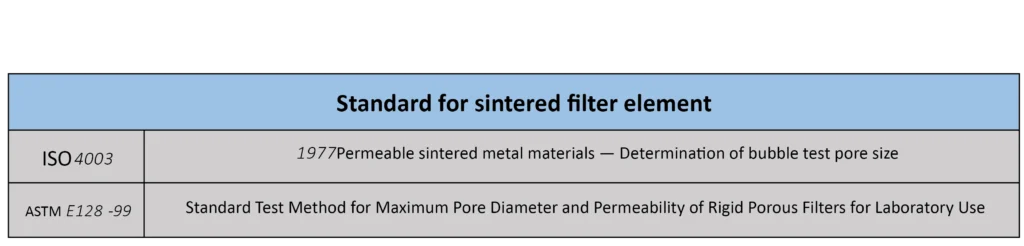
Certain standard tests are used to determine the filter performance of sintered elements.The selection of tests depends on the type of fluid and the material used. The table below lists suitable standards for testing these types of filters.
The production of sintered filters involves several key steps, outlined below:
Selecting Raw Materials: The choice of raw material is crucial and should be based on the fluid being filtered, operating conditions (such as temperature and pressure), cost considerations, and manufacturing feasibility. Various materials, including metals, polymers, and ceramics, can be utilized. Preparation methods for these raw materials may include grinding, atomization, or chemical decomposition.
Molding Powder Particles: Metal powder is placed in a mold and compacted at room temperature under high pressure. The required pressure depends on the material’s elasticity. Molding can be performed in a conventional manner or using an isotropic press, which introduces the metal powder radially. This method offers precise control over the thickness of the porous metal and accommodates a diverse range of metals.
Thermal Bonding or Sintering: In this stage, metal particles are bonded together at high temperatures without reaching their melting point, resulting in a solid structure.
Sintering Process:
One of the primary advantages of sintering is the ability to consolidate materials into a cohesive structure without melting. This occurs due to the driving force of reducing surface energy, which is achieved when a powder (with a higher specific surface area) is transformed into a bulk component (with a lower specific surface area). Although complex, this process can be described in three fundamental stages:
– In the initial stage, necks form and grow between adjacent particles.
– During the intermediate stage, grain growth begins, and the interparticle voids become rounded while remaining interconnected.
– In the final stage, further grain growth occurs, and the pores merge into spherical cavities.
Additionally, pressure-assisted sintering can be employed, applying external pressure to facilitate pore removal and enhance filtration efficiency.

Sintered metal media are created by pressing metal powder into porous sheets or tubes, followed by a high-speed sintering process. The combination of powder size, pressing action, and sintering conditions determines the strength and permeability of the final porous element. The pore size of the sintered metal medium is specified according to the standards discussed in the next section.
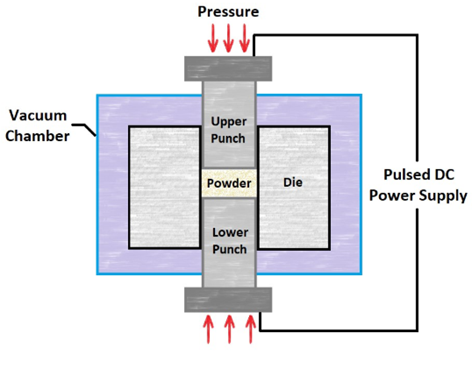
Pulsed electric current sintering is an advanced technique used to agglomerate fine powders from various materials. In this method, a combination of uniaxial compression and pulsed direct electric current is applied to heat the sample to the desired temperature. The necessary heating is achieved through the Joule effect, eliminating the need for an external heat source. This approach allows for the production of fine-grained materials with uniform density and minimizes grain growth due to rapid heating rates. Additionally, this process requires less time and material. Figure 3 illustrates the flow of this process schematically.
The powder bed fusion (PBF) process encompasses techniques such as electron beam melting (EBM), selective laser sintering (SLS), and selective laser melting (SLM). In this process, a heat source—either a laser or electron beam—melts the metal powder to form a layer, after which excess powder is removed.
SLM was first proposed by the Fraunhofer Institute in 1995 and further developed by MCP in 2003. Since then, commercially available equipment has been produced by companies like EOS, Concept Laser, and ILT. SLM is a precision technology employed to create complex metal structures. The process occurs within an inert gas chamber where a spreader distributes the metal powder, and a high-density laser scans across it, melting the powder layer by layer to form bulk materials through metallurgical bonding.
Pressure Drop in Sintered Filters
In sintered filters, the pressure drop increases to a certain maximum value during operation. Once this threshold is reached, a reverse washing process is initiated for reuse. The accompanying diagram illustrates the pressure drop and wash cycle. During filtration, the thickness of the cake increases to a point where the pressure drop of the fluid flow peaks under specific flow conditions and viscosity. After reaching this condition, the filter is cleaned using reverse gas flow, which removes accumulated solids from the surface. Additionally, solids can be agitated through the reverse slurry medium, or through quenching techniques.
Sintered filters are ideal for industrial applications due to their exceptional properties, including resistance to pressure, heat, and chemicals. They are effective in harsh environments and can be evaluated based on their mechanism and structure for usability and reusability. Consequently, these filters are crucial in ensuring the quality of final products while reducing maintenance costs. Various types of sintered filters are available, constructed from metals, ceramics, and polymers, allowing for selection based on factors such as fluid type, temperature, pressure conditions, and chemical resistance.
It is important to note that using these filters necessitates high-precision facilities and adequate materials. The manufacturing technologies involved are complex, and specific conditions must be considered when selecting this filter model.
Author: Forough Khalili

 Save the post
 Projects: