


Nanotechnologists have discovered new filtering media for effective filtrations. The nanofiber-based filtering media, made up of fibers of diameter ranging from 100 to 1000 nm, can be conveniently produced by electrospinning technique. This article addresses the current state of the art in filters by using nanofibrous filtering media. These filtering media are being surface-modified to improve their efficiency of filtration. The developmental objectives for improving the nanofiber-based filtering media are lower energy consumption, longer filter life, high filtration capacity, and easier maintenance; which are elaborated from the manufacturing point of view. Some practical constraints like pleating of thin, extremely low weight, and delicate membranes are also discussed. Nanofibrous filtering media could be used for filtration of blood, water, air, beverages, gases, chemicals, oils, diesel and petrol, etc.
Manufacturing and processing companies in food, pharmaceuticals, biotechnology, and semiconductor businesses require centralized air conditioning in the production environment, high-purity water, clean gases, and effluent/waste air and water treatment. The control over airborne and waterborne contaminants, hazardous biological agents, allergens, and pollutants is a key issue in food, pharmaceuticals, and biotechnology processes. The particle size of particulate matter is determined by the process that generates the particles. For instance, combustion particles are usually in the 10–50 nm size range, but when they combine with other particles and agglomerate form larger particulates. The agglomerate particles may be broken down into smaller particles and released into the air. It is difficult to break down such particles smaller than 0.5 µm [1]. The existing high-efficiency air filters effectively filter particles of 0.3 µm and above. However, they are not sufficient for the filtration of smaller pathogenic agents like viruses.
Air and water are the bulk transportation medium for transmission of particulate contaminants. The contaminants during air filtration are complex mixtures of particles. The most of them are usually smaller than 1000 µm in diameter. Chemical and biological aerosols (particulates) are frequently in the range of 1–10µm. The particulate matters may carry some adsorbed gaseous contaminants. The removal of particulate and biological contaminants is an important step in the water purification process. Particulate contaminants if not removed tend to foul reverse osmosis membranes and severely reduce the throughput of the final purification step. The filtration industry is looking for energy-efficient high-performance filters for the filtration of particles smaller than 0.3 µm and adsorbed toxic gases.
Figure 1 shows the classification of fibers based on their diameter. Nanofibrous media have low basis weight, high permeability, and small pore size that make them appropriate for a wide range of filtration applications. In addition, nanofiber membrane offers unique properties like high specific surface area (ranging from 1 to 35 m2/g depending on the diameter of fibers), good interconnectivity of pores, and the potential to incorporate active chemistry or functionality on the nanoscale.
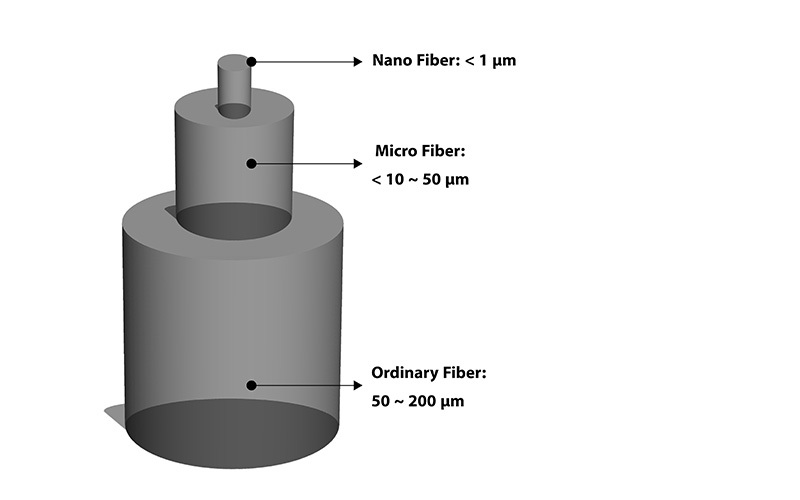
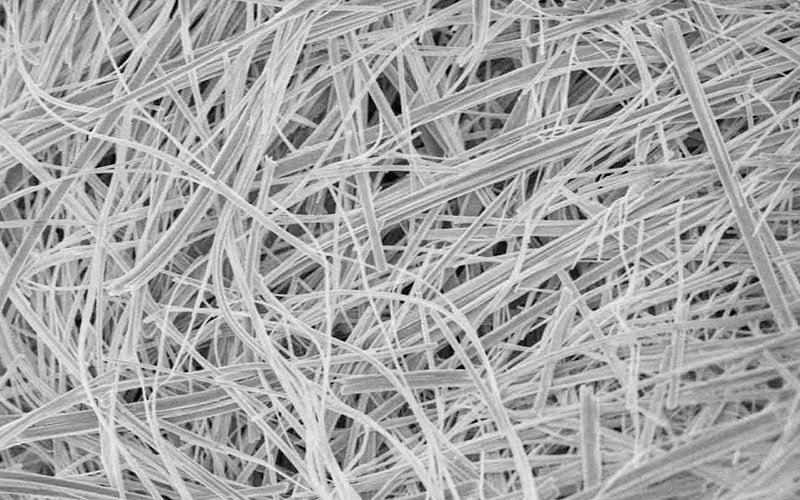
Therefore, nanofibrous membranes are extensively being studied for air and liquid filtration, protective clothing, biomedical applications including wound dressings and drug delivery systems, as structural elements in artificial organs and in reinforced composites. Scanning electron microscopic picture of nanofibrous filtering media is shown in Figure 2.
Structural characteristics of nanofibrous filtering media
a) thickness (and variation with location);
b) fiber diameter (and distribution);
c) representative pore size (and distribution);
d) porosity;
e) tortuosity factor (which is an indicator of geometry and interconnectivity of pores).
History of the production of nanofibrous filter media
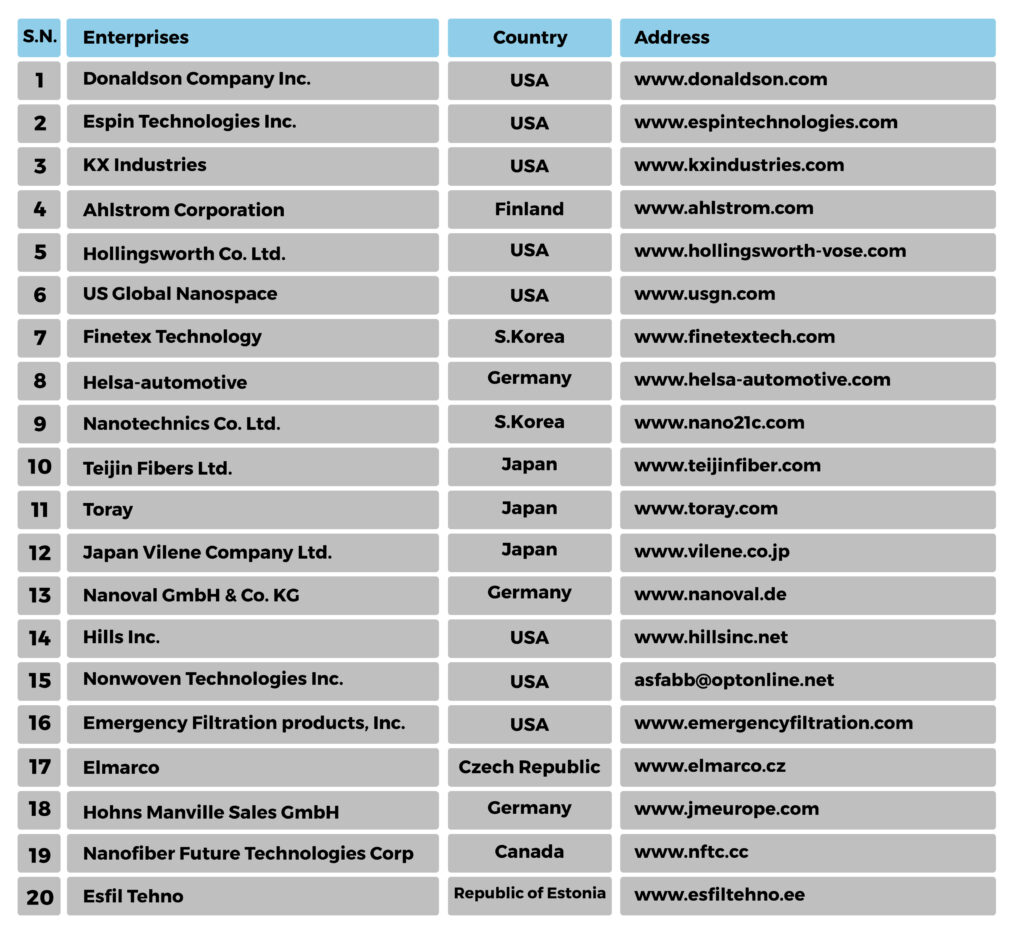
The first patent for the production of fibers from a solution jet introduced into the electric field was issued in 1902 in the USA [2]. The practical results in the production of nanofibrous material from polymer solutions were also obtained by A. Formhals in Germany and patented in the USA in 1934 [3]. In 1936, I.V. Petryanov-Sokolov’s work of fine fiber production in electrostatic fields has given the way for the development of the production of filter materials, these materials are known since then in Russia as FP (filters of Petryanov, which is now called as nanofibrous filter media) [4]. The scientific activities related to the production of Petryanov filters was announced as the top secret because of this Petryanov’s research work never reached the Western Community [4]. After the Second World War, special emphasis was given to application of Petryanov filter materials in nuclear energy technologies for protecting the environment from nuclear-active aerosol release [4]. Most of the research work on the production of nanofibers was carried out at Karpov’s Scientific Research Institute of Physics and Chemistry (Moscow). By the end of the 1960s in the USSR there were 5 enterprises, producing materials of FP type and their modifications with the annual capacity of 20 million m2 (600 tonnes) [1]. In 1964 in Sillamyae (Estonia), a chemical plant was constructed with the largest facility for production of the nanofibrous filter materials [1]. Advances in the electrospinning method allowed the organization of the industrial production of more than twenty types of fiber filter materials [5]. In America, the production of nanofibrous materials gained momentum in 1980 with the efforts of “Donaldson”. In Europe, the commercial production of fibers by electroforming method started in 1990s by “Freudenberg” [1]. A cursory search on the internet has revealed that more than twenty enterprises are keeping interest in either production or use of nanofiber filter media (Table 1)
A few prototype applications of nanofibrous filtering materials are summarized in Table 2.
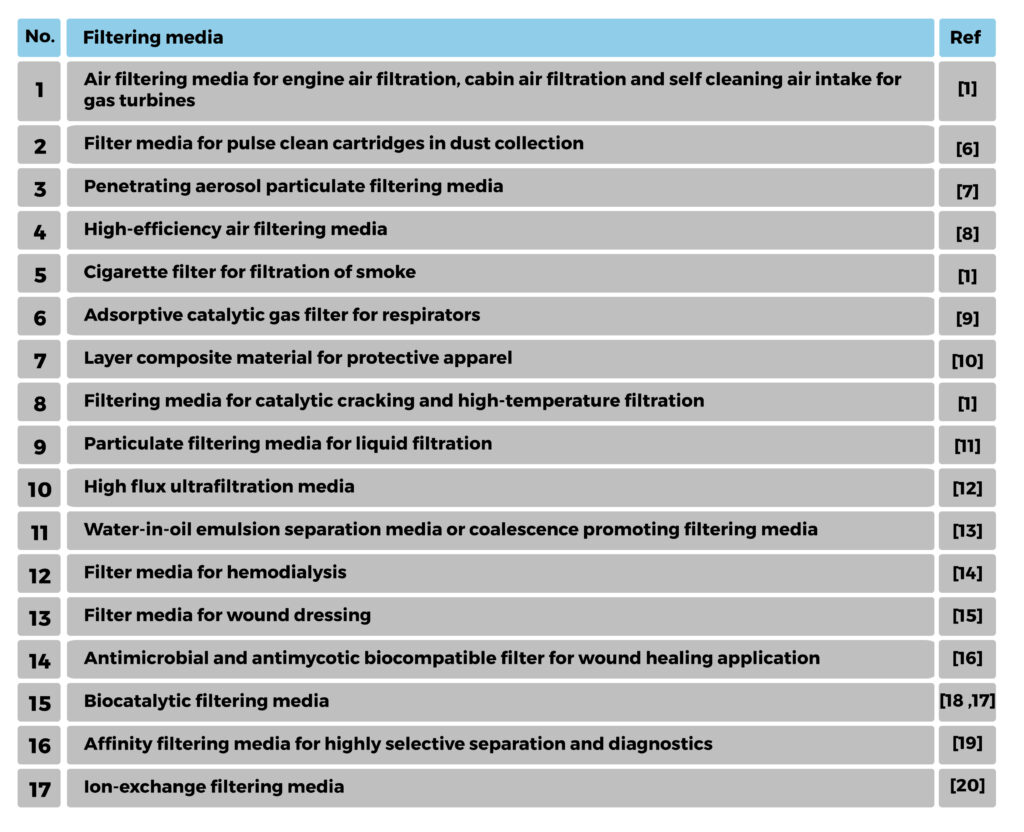
Noteworthy applications of nanofibrous filtering media
Penetrating aerosol particulate filtering media
Theoretical predictions and preliminary investigations indicate that significant increase of the filter efficiency for the most penetrating particle size (between 0.1 and 0.5 µm) accompanied by only a slight rise of the pressure drop, can be achieved by using the nanofibrous filtering media [1]. Recent research work of Podg´orski et al. [7] also shows that fibrous filters containing nanofibers are very promising and economic tools to enhance filtration of the most penetrating aerosol particles. Nanofibrous filtering media can be used where high-performance air purification is needed such as in hospitals, healthcare facilities, research labs, electronic component manufacturers, military and government agencies, food, pharmaceutical, and biotechnology companies. Podgo´rski et al. [7] recommended triple layer design of fibrous filters dedicated to remove the nanoparticles along with other polydispersed aerosol particles (the back support layer of densely packed microfibers, the middle nanofibrous layer for collection of most penetrating aerosol particles and front porous layer of fibers of a few micrometers diameter for collection of micrometer-sized particles).
High-efficiency air filtering media
High efficiency particulate air (HEPA) filters have minimum removal efficiency of 99.97% of particles greater than or equal to 0.3 µm in diameter. The filtration efficiency of Nylon 6 nanofilter (made by the fibers of diameter 80–200 nm and having basis weight 10.75 g/m2) is measured using 0.3 µm challenge particles at the face velocity between 3 and 10 cm/s and found to be superior to the commercialized HEPA filter [8].
Antimicrobial air filter
Heating, ventilating and air conditioning (HVAC) air filters indented for air purification operating in dark, damp and ambient temperature conditions are more susceptible for bacterial, mold and fungal attacks. The situation become worse when these microorganisms adhere to the accumulated dust on the filter and consume the accumulated dust as food and proliferate. As a result there is unpredictable deterioration of the quality of air and production of bad odor. The most common attacking microorganisms on HVAC filters are from Staphylococcus, Serratia, Klebsiella, Cladosporium, and Aspergillus species [21]. Recently, there is an attempt to functionalize the surface of filtering media with antimicrobial agents for long-lasting durable antimicrobial functionality [22]. This concept of introducing antimicrobial functionality over the particulate filters is needed to explore in more systematic fashion because most of these microorganisms often become resistant and limit the benefits of antimicrobial functionality. Furthermore, the most of the microorganisms enter to the filter with airborne particulate and they grow in size on their accumulation and build up on the filter surface. This considerably reduces the contact of microorganisms with antimicrobial agent/s present on surface of filter and further limits the intended benefits. Metallic silver and silver oxides are safe and effective antimicrobial agents at low levels [23]. Positively charged silver ions attract to electronegative bacterial cells and bind with the sulfhydryl group of cell membrane or bacterial DNA and result in the prevention of the proliferation of microorganisms [24]. Ionic plasma processing (IPD) is a suitable method for coating surface-engineered nanosized silver particles on polymeric surfaces [25]. The IPD technology is adoptable because it can be used at ambient temperatures.
High flux ultrafiltration membrane
Porous polymeric ultrafiltration membrane manufactured by the conventional method (phase immersion method) has its intrinsic limitations, e.g. low flux and high fouling tendency due to the geometric structure of pores and the corresponding pore size distribution [1] and undesirable macro-void formation across the whole membrane thickness [25]. Recently, Yoon et al. [12] have shown that porous electrospun nanofibrous scaffolds (porosity larger than 70%) can be used to replace flux limiting asymmetric porous ultrafiltration membranes (of porosity in the range of 34%). Yoon et al. [12] have recommended the three-tier approach to fabricate high flux and low fouling ultrafiltration membranes. In their study, polyacrylonitrile nanofibrous layer was supported on the nonwoven microfibrous substrate (melt-blown polyethylene terephthalate mat), and water resistant but water-permeable coating of chitosan was applied over the nanofibrous layer.
Coalescence filter
In recent years, water in oil emulsion separation has received greater attention. In many applications, dispersions of water drop sizes of less than 100 µm are very difficult to separate. The coalescence filter is economical and effective for separation of secondary dispersions [26]. Coalescence filter performance depends on flow rate of feed, drop sizes in the feed, filter bed depth and surface properties of filter material. Fibrous filter media provide the advantage of high filtration efficiency at economical energy costs. Fibrous filter media with large contact areas per unit mass is expected to perform better in promoting coalescence than the media with lesser surface areas. Addition of polystyrene nanofibers to the coalescence filters (glass fibers) modified the performance of coalescence filters; the filtration experiments have shown that the addition of small amounts of polystyrene nanofibers significantly improve the coalescence efficiency of the filter but also significantly increase the pressure drop of the filters [13]. There exist an optimum amount of nanofibers to be added to the coalescence filter media [27], which balances the desired improvement in coalescence efficiency and the undesirable increase in the pressure drop.
Catalytic filter
Development of both stable and active enzyme systems is still a challenging issue in realizing the successful application of enzymes for industrial applications. Highly specific catalysts like enzymes can be recycled and reused by stabilizing and coating over the surface area of polymer nanofibers. The specific surface area of nanofibrous membrane can be enhanced by reducing the diameter of fibers. Gibson et al. [28] studies show that the electrospinning process can be conventionally used to produce a specific surface area ranging from 1 to 35 m2/g; depending on the diameter of fibers. Fibrous membrane made of porous fibers further enhances the specific surface area of membrane. The specific surface area result from the porous fibers is much higher than that is possible by reducing the diameter of fibers. The nanofibrous media has an advantage over mesoporous media by relieving the mass transfer limitation of substrates/products due to their reduced thickness and intrafiber porosity. Jian et al. [29] demonstrated that the covalent attachment of enzymes to the polystyrene nanofibers.
Affinity filter for highly selective separations
Affinity membranes for highly selective separations are prepared in the laboratory by the surface modification and functionalization of nanofibers [21,30,31]. These membranes are expected to improve performance in preparative scale protein purifications.
Ion-exchange filtering media
Conventional ion exchange resins are normally either a gel structure or a granular structure and are typically made of styrene or acrylic as the structural materials. Granular resinous materials have larger pore volume and lower ion-exchange capacity than gel-type materials. However, the granular materials have better mechanical strength over gel-type materials. More recently, fibrous materials are recognized as a support for ion-exchange functionality due to ease of preparation, contact efficiency, physical requirements of strength, and dimensional stability [32]. Polymeric nanofiber-based ion exchanger has high swelling behavior compared to other media because of high surface area, porosity and capillary motion [20]. In addition, Polymer nanofiber ion exchanger is found to possess extremely rapid kinetics and higher ion-exchange capacity [20].
Techniques for preparation of nanofibrous filtering media
The challenges realized during fabrication of nanofiber mat are (1) attaining the homogeneity in size (diameter) distribution of fibers in the mat, (2) attaining the uniformity in deposition and orientation of fibers in the mat (thickness and structural indexes) and (3) obtaining durability of fiber layers in the nanofiber mat [33].
There are three major processes for producing nanofibres for fluid filtration media. They include electrostatic spinning (electrospinning), improved modular melt blowing and multicomponent fiber spinning or the ‘islands-in-the-sea’ method [34]. Each process has its advantages and disadvantages. The most versatile process for producing nanofibers is electrospinning [1, 35-37], which is being used to produce nanofibrous membranes over a wide range of porosity ranging from nonporous polymer coatings to macroporous delicate fibrous structures. Electrospinning requires a massive scale solvent recovery from the dilute air stream, which makes the process uneconomic. While the polymer dissolution prior to spinning (up to 10–20%, w/w, solution of polymer) and low operational feed rates (polymer flow of about 0.01–0.30 g per orifice per minute) limit the throughput from the process. Furthermore, important polymers such as polypropylene, polyethylene terephthalate, and PTFE (Teflon) are not dissolvable in acceptable organic solvents at room temperature. The polymer flow rate of 0.8–1.2 g per orifice per minute is generally considered to be an economically viable for commercial-scale operation [34]. For a viable nanofiber production process, an electrospinning station must have 10–20 times the number of orifices per meter of the standard equipment available in the market. Electrospun fibers have diameters smaller than that of the melt-blown fibers. Currently, there are investigations aimed at improving of the melt blowing technique to produce nanofibers [38]. Ability to produce large quantities of nanofibrous filtering media with precise controlled porosity (interfiber and intrafiber) is still unresolved issue.
Benefits from nanofibrous filtering media
The dependence of filter characteristics such as pressure drop, filter efficiency and surface area on the geometric structure of fibrous filter media is of great practical significance.
Pressure drop
For nanometer-scale fibers, the effect of slip flow at the fiber surface has to be taken into account. This is because the scale of the fiber becomes small enough that the molecular movements of the air molecules are significant in relation to the size of the fibers and flow field. Knudsen number is used to describe the importance of the molecular movements of air molecules at the fiber surface to the overall flow field. The Knudsen number can be written as
where “λ” is the gas mean free path (the dimension of the noncontinuous nature of the molecules), and Rf is the mean radius of the fibers. When Kn becomes non-legible, the continuous flow theory (which does not take into account the molecular nature of air) starts to become less valid. There is no exact Kn above which slip flow will prevail. Slip flow generally needs to be considered when Kn > 0.1. Slip flow definitely needs to be considered when Kn is around 0.25. For air at standard conditions, the mean free path is 0.066 µm; therefore, for fibers with diameters smaller than 0.5 µm, slip flow must be considered. In slip flow, the air velocity at the fiber surface is assumed to be non-zero. Due to the slip at the fiber surface, drag force on a fiber is smaller than that in the case of non-slip flow, which translates into lower pressure drop [39].
Filtration efficiency
Air filtration
In the case of air filtration, pores size is not a complete indicator of the efficiency of filtration. Air filters have traditionally been evaluated based on their ability to remove particulate matter from the air stream. Particulate filters separate the particles from the air stream by virtue of size, shape, and charge of particles in relation to the surface, size, and charge properties of fibrous filters. Different filtration media rely on different physical interaction mechanisms for the separation and collection of particles. Each filtration medium and its associated interaction mechanisms result into different efficiencies for particles of different sizes. The most common interaction mechanisms are direct interception, inertial impaction, Brownian diffusion and gravity settling. The total efficiency of filter (E) is resulted by collective contribution of individual efficiencies from the above interaction mechanisms. The larger particles more than 10 µm deviates from air stream before reaching to the filter because of gravitational settling. The following particle ranges can be approximately assigned to these interaction mechanisms (Figure 3).
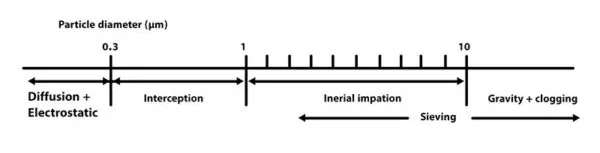
Very small nanoparticles are effectively filtered even in conventional microfibrous filters due to very efficient mechanism of Brownian diffusion [7]. The larger particles (greater than 0.3 µm) are filtered by the impaction and interception. The maximum penetrating particles from air filter are about 0.3 µm in size (which justify why HEPA filter testing is often recommended by using challenge particles of diameter of 0.3 µm). This result was anticipated in 1942 by Dr. Irving Langmuir, which led to the development of HEPA filters.
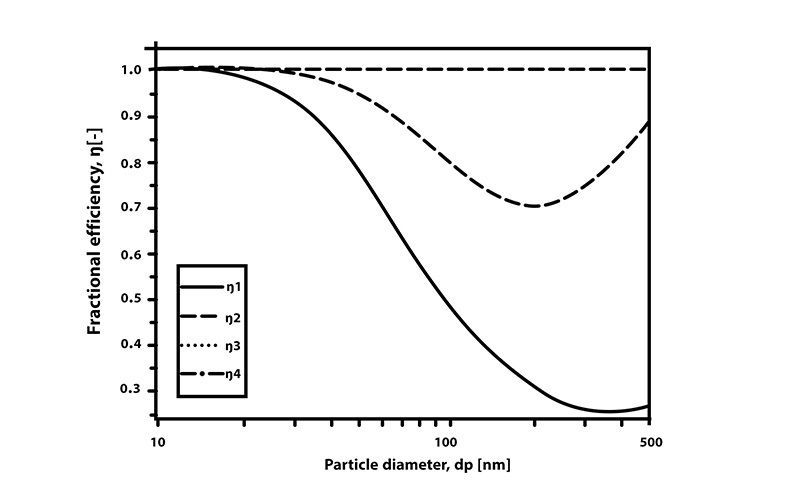
Podgorski et al. ´ [7] estimated performance of nanofibrous media for filtration of particles of a diameter of 10–500 nm; simulated filtration performance considering two predominating mechanisms namely Brownain diffusion and the direct interception for the filters defined in Table 3 is shown in Figure 4.
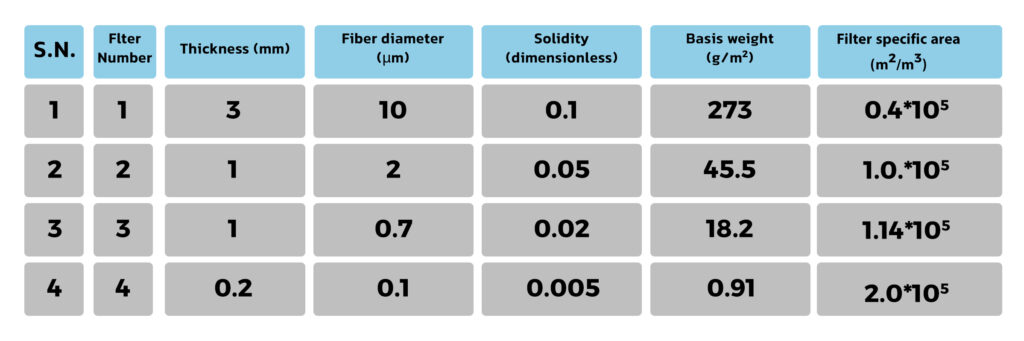
Figure 4 illustrates the effect of decreasing the fiber size in a filter media on filtration performance at the most penetrating particle size range (i.e. the particle diameter corresponding to the lowest fractional efficiency point in the curve) and enhancing fractional efficiency.
Liquid filtration
In a research group, using polystyrene particles of size 0.1–10 µm, particulate filtration performance of nanofibrous filtering media from the liquid medium was evaluated [40]. It was observed that an electrospun membrane conveniently rejects the microparticles and acts as a screen filter without fouling the membrane especially when the particles are larger than the largest pore size of the nanofibrous membrane. High surface to volume ratio of nanofibrous media enhances the fouling. Therefore, surface modification of nanofibrous screen filter with suitable hydrophilic or hydrophobic oligomer is often recommended to reduce the fouling effect.
Surface area
Gibson et al. [28] estimated the specific surface area of nylon 6, 6 fibers as a function of diameter and denier of fibers. The membranes prepared by the approach of reducing the diameter of fibers had extremely small pore diameters (ranging from 0.1 to 0.8 µm in size) [28], which leads to high air flow resistance. These nanofibrous coatings are suitable for filtration and moisture management in applications like responsive textile and protective clothing. For an integrated operation like adsorptive filtration, the membranes must have enhanced surface and flow properties. Filtering media made of porous nanofibers and microfibers would be promising for adsorptive filtration applications.
Developmental objectives while improving the nanofiber-based filtering media
Specific surface area
The specific surface area of fibrous materials can be considerably enhanced by introducing the micropores (less than 2 nm) and mesopores (2–50 nm) in the fibers. Phase separation during the fiber formation process can be conveniently used to introduce the fine pores or phase morphologies in the fibers [1,41]. Phase separation accomplished from the two components system (polymer/solvent system) provides a single stage process to create the fine pores in the fibers. The phase separation accomplished from the three components system (polymer-1/polymer-2/solvent system) requires an additional extraction step to selectively remove the finely dispersed phase morphologies of polymers from the dried fibers and to create pores in the fibers. Recently, McCann et al. [42] reported a method for creation of pores in the fibers wherein the partially dried jet (wet fiber) produced from the two-component system is frozen by passing through a bath of liquid nitrogen before collecting on the target. Due to the sudden reduction in temperature during the freezing step, phase separation sets in the partially dried jet resulting into the formation of a solvent-rich phase (dispersed phase) and a polymer-rich phase (continuous phase). The dispersed solvent-rich phase from the partially dried frozen fibers was selectively removed by a vacuum drying process [42]. Since the phase separation is attained at very low temperatures; this method requires an additional step like vacuum drying to remove the dispersed solvent-rich phase morphologies.
Mechanical and filtration properties
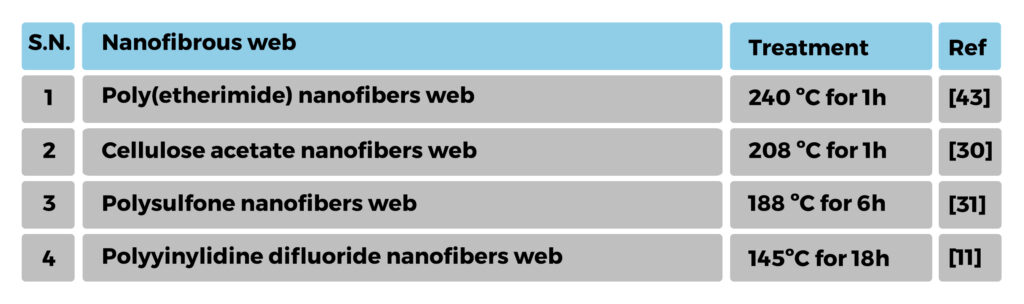
The mechanical strength of nanofibrous membranes is not sufficient to withstand macroscopic impacts during filtration applications such as normal liquid or air flows passing through them. Hence, they need to be used as an active coating layer on existing melt-blown supportive fibrous media (substrates) or the fibers need to be bonded to enhance mechanical properties. The substrates like melt-blown supportive fibrous provide appropriate mechanical properties to allow pleating, filter fabrication, durability in use, and in some cases filter cleaning [1]. In addition, the substrate also serves as a safety filter in case of inadvertent damage to the nanofiber layer during use. Thermal treatment of nanofibrous web above the glass transition temperature (more precisely between the glass transition temperature and melting temperature) joins the fibers at nodes (designated as interfiber bonding) and improves the interpore connectivity in the web; thereby improves the filtration capability of the web. Interfiber bonding makes the web rigid and mechanically stronger (by enhancing the tensile strength). Treatment conditions depend on the molecular weight of the polymer and molecular weight distribution. Treatment conditions to promote the interfibers bonding in nanofibers of common polymers are given in Table 4.
For the better adhesion between the fibers, less concentrated polymer solutions containing solvents of high boiling points are often useful. Porous fibrous structures can be prepared from 10 to 20% solutions of polymers in low boiling solvents with boiling point above 100 ◦C. The fibers with residual solvents can stick together at a large contact points without deformation. In this case, upon evaporation of solvent, the fibrous materials have, on the one hand, mechanical properties close to those of continuous film and, on the other hand, this approach helps to retain porosity of the web [51].
Surface modification and functionalization
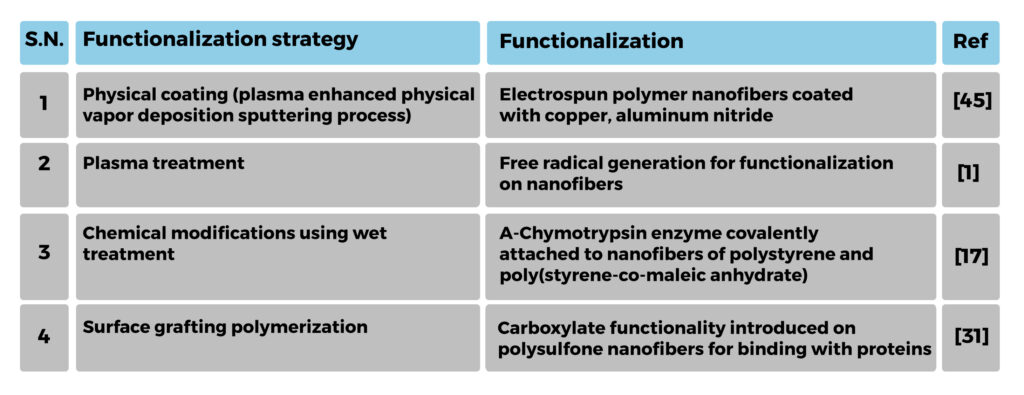
Most of polymeric nanofibers are chemically inert and do not perform any functions other than filtration. The surface of nanofibers can be modified to incorporate specific functional group or functionality. Approaches used to modify the surface of nanofibers are summarized in Table 5. The challenges associated with coating and surface modification of nanofibrous filtering media are (a) uniformity in surface modification or coating, (b) ultrathin coatings without affecting the filter pore size and (c) surface modification or coatings on large volumes of nanofibers on routine basis for commodity and specialty filtering media.
In the last decade, applications of nanofibrous filter media are increased rapidly. With focused advances in melt blowing and electrospun technology, mass scale production of nanofibers is becoming easy. Surface modification for nanofibers needs to keep its pace with production processes. Compared to conventional commercial webs, nanofibrous webs have a large specific surface area and small pore size. Therefore, polymer nanofibers are being used or found to be used in industrial and biomedical fields. In particular, in this study, the application of filtration media using nanofilters made by nanofibers has been investigated. Surface modification for nanofibers should be synchronized with the manufacturing processes.
Author: Amin Forouzan
September 2023

 Save the post
 Projects: