


Microfiltration (MF) is one of the oldest and most widely applied pressure-driven membrane processes, based on the physical separation of particles, microorganisms, and colloids in the size range of 0.1–10 μm. Due to its relatively low operating pressure, ease of operation, and high separation efficiency, MF has found extensive applications in water treatment, food processing, pharmaceutical manufacturing, biotechnology, and liquid and gas sterilization. The performance of MF membranes is strongly influenced by membrane material, pore size and distribution, module geometry, and hydrodynamic operating conditions. Fouling remains the major challenge of this technology, leading to flux decline, increased energy consumption, and frequent chemical cleaning. Recent advances in polymeric and ceramic membranes, hollow fiber module design, and fabrication techniques such as phase inversion, stretching, and track-etching have improved fouling resistance and operational stability.
A membrane is a semi-permeable, engineered barrier that allows the selective transport of one or more components. This selectivity is driven by gradients in pressure, concentration, temperature, or chemical potential across the membrane. Based on the dominant driving force, membrane processes are classified into pressure-driven, thermally driven, electrically driven, and concentration-driven processes. Among these, pressure-driven membrane processes—including microfiltration (MF), ultrafiltration (UF), nanofiltration (NF), and reverse osmosis (RO)—have the widest industrial applications.
Microfiltration is one of the most fundamental membrane separation techniques and relies primarily on the physical retention of suspended particles and microorganisms. In this process, the feed stream passes through a membrane with defined pore sizes, allowing particles in the range of approximately 0.1–10 μm—such as suspended solids, colloids, bacteria, and yeast cells—to be retained. The dominant separation mechanism in MF is sieving, meaning that particle rejection is mainly governed by pore size and membrane structure. Consequently, MF typically operates at relatively low transmembrane pressures, usually between 1 and 5 bar.
Since microfiltration is capable of removing a wide range of colloidal particles, microorganisms, and insoluble contaminants, its role as a pretreatment in many advanced membrane systems such as ultrafiltration (UF) and reverse osmosis (RO) is highly crucial. This process is considered one of the oldest commercially available membrane technologies and is currently widely employed in industries such as water treatment, pharmaceuticals, food, biotechnology, beverages, and sterilization. The separation efficiency in MF membranes, in addition to pore size and distribution, depends on membrane surface charge, surface energy, constituent materials, module structure, flow hydrodynamic conditions, and the type of contaminants present in the feed. This dependency has made the design and selection of MF membranes require simultaneous consideration of structural, functional, and operational characteristics. The ability to effectively remove particles and maintain adequate stability against physical and biological fouling renders MF a versatile, flexible, and economical separation technology.
In membrane separation processes, the flow configuration and the manner in which the feed contacts the membrane surface play a critical role in boundary-layer hydrodynamics, fouling behavior, permeate flux, and long-term operational stability. In microfiltration, three main filtration modes are commonly applied: dead-end filtration, cross-flow filtration, and hybrid-flow filtration.
In dead-end filtration, the feed flow is applied perpendicular to the membrane surface, and the entire feed stream is forced through the membrane pores. Suspended particles and colloids accumulate directly on the membrane surface, leading to the rapid formation of a compact cake layer. This results in increased mass transfer resistance, flux decline, higher pressure drop, and accelerated fouling.
Due to the rapid accumulation of particles, the dead-end mode is mostly employed in batch, small-scale, and laboratory processes. Common industrial applications include:
• Filtration of valuable metallic catalysts in hydrogenation reactions
• Separation of silicon tetrachloride in polysilicon production
• Concentration of aqueous solutions containing lithium fluoride or fine-grained catalysts
• Caprolactam production
In this method, once the flux reaches a critical value, the membrane must undergo surface cleaning, backwashing, or replacement. In cases where the feed has a low solid content and a low fouling potential, the dead-end mode represents an economical and simple option for primary clarification.
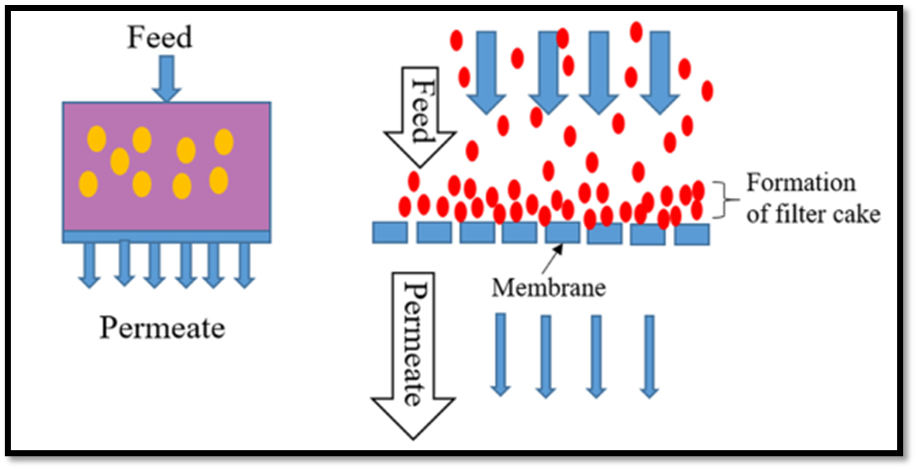
In cross-flow filtration, the schematic of which is shown in Figure 2, the feed flows parallel to the membrane surface, and only a portion of the flow passes through the membrane. This pattern generates a shear force on the membrane surface, resulting in:
The parallel flow increases turbulence in the boundary layer and enhances mixing between the particles and the bulk fluid. Consequently, accumulated particles are more effectively removed from the surface, and the likelihood of severe fouling decreases. For these reasons, cross-flow is the preferred choice in applications with a solid load exceeding 0.5%. Although mass transfer in this method depends on the molecular permeability of the retained materials, and colloidal substances generally exhibit low permeability, the shear induced by cross-flow significantly increases the operational flux of MF compared to UF.

In many industrial processes, feed conditions or operational requirements are such that neither dead-end nor cross-flow alone is sufficient. Under such circumstances, the hybrid-flow mode is employed (Figure 3). In this pattern:
There are two main phases:
This pattern is utilized in systems such as UF/MF to enhance flux stability, reduce operational downtime, and increase the overall efficiency of the unit.

The appropriate filtration pattern in microfiltration systems depends on a set of operational factors and feed characteristics. One of the most important criteria is the solid feed load. Typically, when the solid concentration is below 0.1%, the dead-end mode provides satisfactory performance. However, for concentrations in the range of 0.1% to 0.5%, the use of dead-end mode together with a protective prefilter or employing a hybrid-flow pattern is recommended. When the solid load exceeds 0.5%, cross-flow operation becomes essential, as particle accumulation under such conditions rapidly leads to membrane fouling. The nature and behavior of the particles also play a critical role in selecting the filtration mode. Hard or incompressible particles are generally well-separated in dead-end mode, whereas soft, sticky, gel-forming, and colloidal particles have a strong tendency to foul, making cross-flow or hybrid-flow modes more effective. In applications where the recovery of valuable materials or concentration of solutions is important, dead-end or hybrid-flow modes are preferred because they retain particles within the flow path. On the other hand, if the process is sensitive to frequent stoppages or continuous cleaning—particularly in food, pharmaceutical, and desalination units—cross-flow is the superior choice due to greater flux stability and reduced fouling rate. Thus, the selection of the filtration pattern is a balance among separation quality, operational stability, and the economic requirements of the process.
Microfiltration membranes can be manufactured from a wide range of polymeric and inorganic materials, each exhibiting different structural and operational characteristics. These membranes, by providing micro- and submicron-scale pores, allow selective separation of particles, colloids, and microorganisms, and their performance depends on permeation rate, pore size, and surface energy. Among various materials, polymeric membranes—including polyethylene, polypropylene, polyvinylidene fluoride (PVDF), polyethersulfone (PES), and polytetrafluoroethylene (PTFE)—hold a major market share due to fabrication flexibility, lower cost, and the possibility of producing various geometries. In contrast, ceramic membranes, typically made of alumina, zirconia, silicon carbide, or titania, are used in harsh or corrosive environments due to their high thermal, chemical, and mechanical stability.
A significant portion of commercial membranes today is produced using methods such as melt-blowing, in which fibers or thin sheets with paper-like structures are formed and subsequently pleated in filtration cartridges (Figure 4). These structures provide high effective surface area and enable fine filtration, making them common in many industrial microfiltration systems. Generally, microfiltration membranes are divided into two main categories: polymeric and ceramic. However, advances in technology have enabled the production of composite membranes, which, through techniques such as solution coating, interfacial polymerization, or thin-film deposition, combine structural characteristics of both types. These multilayer membranes improve mechanical strength, selectivity, and fouling resistance, playing an important role in advanced microfiltration applications.

Polymeric membranes for microfiltration are produced using a wide array of fabrication methods, each imparting specific features regarding porosity, pore size control, and mechanical stability. Major methods include stretching, track-etching, sintering, phase inversion, and solution coating. The primary difference among these methods lies in how porosity is generated and the microscopic structure of the membrane, ultimately affecting permeate flux, fouling resistance, and selectivity.
Stretching is one of the most common technologies for manufacturing polymeric microfiltration membranes. In this method, an extruded film of crystalline or semicrystalline polymers is subjected to tensile force perpendicular to the extrusion direction. This mechanical stress separates polymer chains and forms a microporous structure. Membranes produced by this method typically have pore sizes in the range of 0.1–3 μm and, due to high porosity, provide adequate flux. Well-known brands such as Gore-Tex and Celgard exemplify polypropylene and PTFE membranes manufactured using this technique.
In the track-etching method, a polymer film is first irradiated with charged particles (typically ions) to create damaged points or linear tracks in the structure. The film is then etched in acidic or alkaline media to convert these tracks into uniform, cylindrical pores. Pore sizes in this method can be adjusted from 0.02 to 10 μm, with pore diameter and porosity controlled by irradiation and etching times, respectively. The resulting membranes are highly uniform but have low porosity and are used in precise and sensitive applications.
Sintering is one of the oldest specialized methods for polymeric membrane fabrication. In this method, polymer powder with a specific particle size is compressed under pressure and subsequently sintered at a temperature close to the polymer’s melting point. This process partially fuses particles, eliminates boundaries, and creates a porous structure. PTFE is a suitable polymer for this method. Sintered membranes exhibit high resistance to heat, chemicals, and pressure, and are used in demanding industrial applications.
Phase inversion is the most widely used and flexible method for fabricating polymeric membranes. It is based on separating a polymer solution into two phases: a polymer-rich phase forming the membrane matrix, and a polymer-lean phase forming pores. Pore type and structure depend on the phase transfer rate, solvent–nonsolvent system, and process conditions. Common solvents include NMP, DMAc, and DMSO. This method allows the production of asymmetric membranes, hollow fibers, flat sheets, and multilayer structures.
Composite membranes are produced when a combination of high mechanical stability and high selectivity is required. In these structures, a thin, selective top layer is applied on a porous substrate. Techniques such as dipping, plasma polymerization, interfacial polymerization, and in-situ polymerization are used to create this layer. Composite membranes, due to high efficiency and precise structural control, have a significant role in advanced microfiltration technologies.
Ceramic membranes are employed in many industrial applications with harsh operational conditions due to their exceptional thermal and chemical stability. They are mainly made from alumina, zirconia, titania, and silicon carbide and are designed as symmetric or asymmetric structures depending on the fabrication method. Two conventional ceramic membrane fabrication methods are the slip casting and extrusion (uniaxial pressing) methods.
In slip casting, ceramic raw materials are mixed with binders, porogens, and other additives to form a homogeneous slurry. The slurry is poured into tubular or disc molds and kept under uniform pressure for 24–48 hours to stabilize the initial shape. The sample is then subjected to sequential thermal treatments including drying, staged heating, and finally sintering at an appropriate temperature determined by tests such as XRD and TGA. The membrane surface is polished with silicon carbide abrasives to remove irregularities.
In uniaxial pressing, the raw material mixture is placed in a mold and compressed under high pressure, typically 30–50 MPa. The sample is then dried and sintered similarly to the slip casting method. Raw material type, particle size, heating rate, and cooling conditions are key factors affecting porosity and final membrane strength.
In addition to conventional methods, advanced techniques for producing ceramic membranes with diverse shapes and porosities include:
MF and UF membrane configurations are categorized based on geometry and module arrangement into four main types: flat sheet, tubular, spiral-wound, and hollow fiber. Flat sheet membranes generally have channels 0.5–2.5 mm wide and are widely used in laboratory and pilot-scale units due to their simplicity and ease of cleaning. Tubular membranes with 6–25 mm internal diameter offer lower hydraulic resistance and are suitable for high-solid feeds. Spiral-wound and hollow fiber configurations have been developed to increase membrane surface area per unit volume, with hollow fiber modules being common in UF and MF due to the absence of a dense separation layer. For processes such as RO and NF, which require a fully dense separation layer, spiral-wound modules based on flat sheet membranes dominate industrial applications. For example, Toyobo is the only commercial producer of cellulose triacetate hollow fiber membranes for RO systems, whereas companies like GE, Dow, and Hifulx offer a wide range of hollow fiber UF/MF modules for industrial applications.

Fouling is a fundamental challenge in MF and UF processes, directly affecting performance, separation efficiency, and operational costs. These processes are often analyzed using models based on interactions among the membrane, solute, and solvent. In all models, gradual pore blockage and the resulting additional hydraulic resistance are the main mechanisms for flux decline. Under constant pressure, this resistance increase causes a continuous decrease in permeate flux, while under variable pressures, higher pumping pressure is required to maintain the initial flux.
In MF and UF systems, the accumulation of dissolved or suspended materials near the membrane surface forms a concentrated layer, known as concentration polarization. Persistent concentration polarization leads to stable deposits, including organic compounds, colloidal components, minerals (e.g., Na, Mg, Al, Si, P, and K), and microorganisms. These deposits may appear as cake layers, gel deposits, or pore blockages. Fouling is categorized as reversible or irreversible: reversible fouling can often be removed by backwashing or hydraulic cleaning, whereas irreversible fouling, caused by cake compaction, internal pore blockage, or sticky gel layer formation, requires chemical cleaning or even membrane replacement.
Fouling increases energy consumption because the system requires higher pressure to overcome the hydraulic resistance, and in the long term, raises operational and maintenance costs while reducing membrane lifespan. Since fouling is the primary limiting factor in industrial MF applications, a significant portion of recent research focuses on developing strategies to reduce, control, or delay fouling, understanding fouling mechanisms in MF membranes, developing anti-fouling membranes, optimizing operational conditions as prefiltration or standalone processes, and investigating specific applications, particularly in the food industry where high organic and colloidal adhesion exacerbates fouling.
In summary, a deep understanding of fouling mechanisms and the development of mitigation strategies—including membrane surface modification, improved hydrodynamic conditions, proper module design, and optimized cleaning methods—are essential for enhancing the stability and efficiency of microfiltration processes.
Microfiltration (MF), as one of the most widespread pressure-driven membrane technologies, plays an important role in the separation of suspended particles, microorganisms, colloids, and solid–liquid suspensions. The development of polymeric and ceramic materials, improvement of module design, and industrial advances have caused the global MF market to become one of the largest sectors of the membrane industry. This market, after medical technologies such as hemodialysis, ranks among the top in terms of commercial volume and research and development investment. Leading companies in this field, relying on innovation, strong marketing, and development of specialized products, have significantly expanded the range of MF applications.
Microfiltration is one of the most important technologies used in the treatment of drinking water, industrial water, and wastewater. Its main characteristics in this field include:
MF is capable of removing turbidity, suspended particles, algae, cysts, and large bacteria. Although viruses are smaller than the MF separation range, the attachment of viruses to larger particles or the formation of aggregates can make their removal possible. In the domestic sector as well, in cases of high turbidity, the use of cartridge microfilters or sand beds is very common. When removal of microorganisms is required, MF or UF systems are more suitable options compared to conventional filtration.
Since the early 2000s, seawater desalination plants have widely used MF/UF as advanced pretreatment for RO. This method, by significantly reducing RO membrane fouling, leads to increased membrane lifetime and reduced operating costs.
Hollow fiber membranes in an outside-to-inside configuration and with very low cross-flow velocity have found widespread application in municipal wastewater treatment. With regular backwash operation, these systems can provide high permeability, adequate clarity, and acceptable sterilization.
MF is one of the key technologies in food fluid processing due to low operating temperature and preservation of sensory and nutritional quality.
Main applications:
These applications result in final products that are clearer, more stable, and with better organoleptic quality. However, organic and biological fouling is one of the main challenges of MF use in the food industry.
In pharmaceuticals, microfiltration membranes are used as physical sterilization tools in many heat-sensitive processes.
Important applications:
Positively charged nylon membranes have widely replaced old asbestos filters and increase the ability for electrostatic adsorption of particles and bacteria.
MF is used not only for the liquid phase but also for gas sterilization. Some notable applications include:
The ability to remove bacteria without affecting gas flow has made MF one of the main gas-sterilization methods.
In oil and gas refining industries, MF is used to separate solid particles, catalysts, and insoluble contaminants from process streams. This includes:
The chemical stability of ceramic membranes has made the use of MF possible in harsh industrial environments.
One of the growing areas in the beverage and food industry is the replacement of diatomaceous earth (D.E.) filters with microfiltration. MF is able to provide:
However, high initial cost still prevents full replacement of this technology.
In many processes, microfiltration is the first stage of membrane separation:
MF → UF → NF → RO
This sequence helps reduce fouling, increase membrane lifetime, and decrease energy cost.
Microfiltration, as one of the most important membrane separation technologies, plays a prominent role in various industries including water treatment, food industries, pharmaceuticals, biotechnology, and chemical processes. Diversity in membrane materials, fabrication methods, and module configurations has enabled the design of systems with optimal performance for different conditions and feeds. Advances in the production of polymeric and ceramic membranes and the development of novel structures such as composite membranes and hollow fibers have led to a significant increase in efficiency, stability, and application range of this technology.
Nevertheless, fouling remains the main obstacle to sustainable operation of microfiltration processes; a complex phenomenon arising from interactions between the membrane, feed components, and hydrodynamic conditions, ultimately causing flux decline, increased energy consumption, and higher cleaning and maintenance costs.
As studies show, deep understanding of fouling mechanisms, correct selection of membrane type, module configuration, and determination of appropriate operating mode (dead-end, cross-flow, or hybrid) play an essential role in reducing fouling rate and increasing performance stability. Membrane surface modification, design of antifouling structures, control of concentration polarization, and optimization of operating conditions are among the key strategies for improving microfiltration system performance.
Overall, due to operational simplicity, low energy consumption, and ability to separate a wide range of particles and microorganisms, microfiltration remains a fundamental technology in modern membrane systems. With the development of smart membranes, hybrid materials, and advanced cleaning systems, it is expected that fouling-related challenges will be further reduced and this technology will more strongly establish its position in sensitive and advanced applications. Consequently, microfiltration in the near future will not only play a decisive role in water treatment and industrial processes, but will also be widely used as a cornerstone of pretreatment in advanced membrane systems such as ultrafiltration, nanofiltration, and reverse osmosis.
[1] Sutherland, Kenneth S., and George Chase. Filters and filtration handbook. Elsevier, 2011.
[2] Bardhan, A., Akhtar, A., & Subbiah, S. (2022). Microfiltration and ultrafiltration membrane technologies. In Advancement in Polymer-Based Membranes for Water Remediation(pp. 3-42). Elsevier.
[3] Eykamp, W. (1995). Microfiltration and ultrafiltration. In Membrane science and technology(Vol. 2, pp. 1-43). Elsevier.
[4] Rouquie, C., Dahdouh, L., Ricci, J., Wisniewski, C., & Delalonde, M. (2019). Immersed membranes configuration for the microfiltration of fruit-based suspensions. Separation and Purification Technology, 216, 25-33.
[5] Singh, R., & Purkait, M. K. (2019). Microfiltration membranes. In Membrane separation principles and applications(pp. 111-146). Elsevier.
Author: Mahshid Shalkeh

 Save the post
Projects: