


Membrane filtration technology introduces a novel separation approach that cannot be achieved using conventional filter media. Membranes—classified into microfiltration, ultrafiltration, nanofiltration, and reverse osmosis—play a critical role in various industrial applications, including petrochemical processes, water treatment, pharmaceuticals, and food processing. These membranes, manufactured from cellulosic, polymeric, or ceramic materials, enable separation at molecular and ionic scales. Their symmetric and asymmetric structures allow for optimized filtration performance.
Cross-flow filtration systems extend membrane operational life by minimizing fouling and enhancing overall efficiency. Advanced processes such as reverse osmosis and nanofiltration facilitate high-pressure separations, while ultrafiltration and microfiltration accurately remove colloidal particles and bacteria. The integration of these technologies underscores their essential role in achieving precise separations across a wide range of industries.
In the field of filtration and separation technology, membranes have become one of the most critical components. It is almost impossible to separate membrane media from the processes and equipment in which they are used. From a separation standpoint, membranes are defined as thin, flexible, and semipermeable sheets made from various materials, designed to separate species at molecular and ionic chemical scales. Their first major application was in water purification and desalination through the reverse osmosis process—a diffusion-based mechanism that exploits the different diffusion rates of water molecules and ionic species through a membrane material under high transmembrane pressure.
Membranes can be fabricated from various materials that contain molecular-scale pores, enabling the differential diffusion rates required for separation. Commercial membranes today are manufactured from rigid inorganic materials, particularly ceramics, as well as a wide range of polymeric materials. The small pore openings of membranes also make them highly effective for fluid–particle separation, although they impose high operational costs due to the pressure needed for transmembrane transport. Membrane applications span from molecular separation to ultrafiltration and microfiltration. The desire to reduce operational costs led to the development of cross-flow membrane filtration, a field that has now expanded beyond its origins in reverse osmosis. Petrochemicals, food and beverage processing, pharmaceuticals, electronics, biotechnology, and especially water treatment are among the major users of membrane processes.
Today, the term “membrane” may refer to porous or non-porous materials, either polymeric or inorganic. These membranes can be used for a wide range of separations, including solid–liquid, liquid–liquid, and gas–gas separation processes. However, their value in the filtration industry has been particularly demonstrated in the removal of micron-sized and submicron particles from liquids and gases.
In general, there are three major categories of membrane materials:
Although some membrane filter media are not manufactured from a fibrous source or a fiber-forming process—unlike other types of nonwoven filter media—certain membranes exhibit a morphology that resembles fibrous structures. This is evident in the SEM images shown in Figure 1.

For membranes to be effective in filtration and separation processes, they must exhibit chemical resistance, mechanical and thermal stability, high permeability to particles, ions, or molecules (as required), strong selectivity, long-term operational stability, and sufficient strength to withstand the high transmembrane pressures demanded in certain membrane processes.
When particle separation through a membrane is intended, the pore size through which a particle either passes or is retained becomes a key characteristic. A membrane that contains pores with diameters in the range of 0.005 to 1 µm is classified as a porous membrane. A membrane with smaller pores—typically in the range of 0.001 to 0.005 µm (1 to 5 nm)—is known as a microporous membrane.
Pores smaller than 1 nm, which are smaller than most molecular species, are not considered true pores; instead, they are regarded as intermolecular or intercrystalline free-volume spaces. These aperture are so small that their dimensions fall within the same scale as small molecules. The geometric constraints on particle entry and transport eliminate convective flow mechanisms that are typical in pressure-driven fluid mechanics. Instead, the random motion associated with diffusion—arising from molecular collisions—becomes the dominant mechanism driving the transport of species through these ultrafine pores. Membranes possessing such extremely small free-volume spaces are referred to as nonporous or semipermeable membranes.
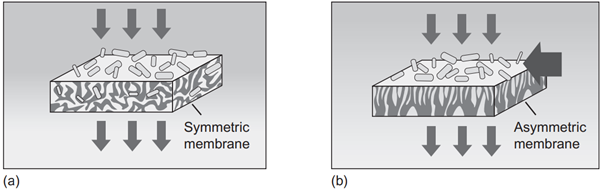
A membrane that exhibits the same chemical and physical structure throughout its entire thickness in the direction of species transport is referred to as a symmetric or isotropic membrane (Figure 2a). If the membrane possesses different chemical and physical structures across its thickness, it is known as an asymmetric or anisotropic membrane (Figure 2b).
The most common type of asymmetric membrane consists of an extremely thin layer of highly selective material (typically characterized by very small pores and low permeability) supported by a much thicker substrate with larger pores and higher permeability. This type of membrane may be fabricated from the same material, produced as an integrated structure with the thin active layer.
The combination of different filtration media is commonly employed in industrial and precision filtration processes. For example, a membrane may be laminated onto a nonwoven fabric to provide additional strength and support.
One of the key characteristics of membranes is their tendency to become easily fouled by very fine or viscous materials. Membrane systems are therefore designed with great precision to minimize fouling as much as possible. The actual membrane surface can also be chemically modified to reduce its susceptibility to contamination.
The development of cross-flow filtration originated from the reverse osmosis membrane process. To minimize cake formation on the membrane surface, reduce fouling, and extend membrane lifespan, cross-flow operation was introduced. In cross-flow operation, the feed stream flows tangentially across the membrane surface rather than perpendicularly to it (Figure 3). Today, virtually all membrane processes operate in the cross-flow mode rather than the normal-flow mode.
Additional surface sweeping is achieved through the relative motion of the membrane medium with respect to the liquid stream, such as rotation near a stator or vibration of the membrane.

Membranes are manufactured in various formats depending on their intended application, including flat sheets, tubes with a wide range of diameters, and solid blocks, onto which the membrane is subsequently deposited. The primary manufacturing processes can be broadly summarized as follows. Particles with fine size distributions are sintered into various shapes, which is the most common method for producing ceramic membranes. Solvent casting or phase inversion involves dissolving the base polymer in a solvent (or a mixture of solvents), followed by the addition of another solvent to precipitate the polymer, and precise evaporation of the solvent to produce flat sheet membranes, or, after extrusion, hollow fibers and capillaries. Extremely fine fibers can also be spun from any base material to form a thin web on a strong porous support; nanofiber membrane filters, often produced via electrospinning, are compatible with nonwoven structures. Impermeable films can be irradiated with specialized beams, such as ion beams, and the irradiated tracks are subsequently etched to create small pores in the film, a method used for precise pore membrane fabrication. In another approach, a thin impermeable polymer film is produced with indentations, then laterally stretched to create cracks at the indentations, forming pores suitable for filtration applications. Additionally, membranes can be fabricated through photolithography on metal sheets, although the open area ratio of such membranes is generally very low.
A membrane piece intended for use as filter media must be securely held in place within a sealed housing to prevent any liquid leakage from one side of the membrane to the other under high transmembrane pressure. Most membrane media are incorporated into modules, which can be easily installed within housings and removed for replacement or cleaning. Membrane modules come in a wide variety of designs, including flat sheets that are held in a plate-and-frame arrangement, with sheets placed back-to-back; the feed liquid flows across the sheets from the inlet side, while the filtered permeate exits through a common outlet between the sheets. Some production processes yield thin sheet-like membranes that can be pleated; when attached to a cylindrical core, these pleated sheets form a cartridge module, which is widely used in microfiltration applications, providing a relatively large surface area within a cylindrical housing, although it cannot withstand high transmembrane pressures.
Long, flat sheets may also be stacked with appropriate spacers and supports to achieve the desired thickness, and then tightly rolled from one of the short ends to form a cylinder. These cylinders are placed in cylindrical housings, commonly referred to as spiral-wound modules. The ends of the membrane sheets are connected to a central porous core. In this configuration, permeate flows through the membrane layers via alternating channels around the roll toward the central tube, while feed enters one end of the cylinder, flows through the interlayer spaces, and exits the other end as concentrate (or retentate).
Tubular membranes, with diameters ranging from a few millimeters to 25 mm, are rarely used outside the laboratory due to their low surface area. In industrial-scale applications, however, these tubes are grouped together similar to shell-and-tube heat exchangers, sealed at both ends with tube sheets, and enclosed within a cylindrical shell. Similarly, hollow fiber modules consist of hundreds or thousands of long hollow fibers with internal diameters ranging from 3 mm down to 0.5 mm or less. These fibers are tightly bundled and sealed at both ends with resin. The bundle may be configured either straight or, more commonly, folded with the inlet and outlet positioned at the center of one end. Feed liquid flows from the outside into the hollow fibers, and the small fiber diameters enable these modules to withstand high transmembrane pressures. This design was used for the first reverse osmosis membrane modules.
Tubular modules utilize slightly larger membrane tubes compared to hollow fibers. These tubes are sealed at both ends with resin plugs but are generally installed open, without folding, inside their cylindrical housing. In this system, the liquid flows from the interior of the tubes outward.

Early membranes were fabricated from a single material, either in a symmetric or an asymmetric configuration. Today, membranes have evolved into composite structures, where the membrane support is made from a material that provides mechanical strength, while the surface consists of a thin layer of another material that imparts high filtration performance to the entire structure. These two (or even more) distinct layers may be combined by layering or by coating the finer layer on the coarser substrate. Nonwoven structures are commonly employed as support layers for membranes.
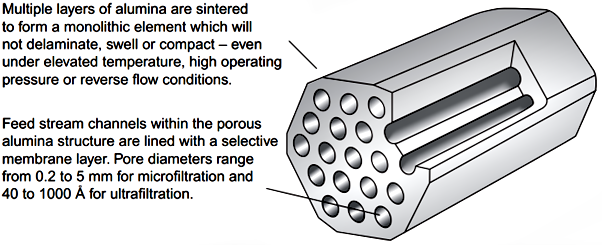
All of the membrane formats described above can be produced from polymeric materials; however, various formats made from inorganic media—particularly ceramic materials—are also available. The standard method for producing a ceramic membrane is to first form a support structure from porous, relatively coarse ceramic particles with suitable flow channels, and then deposit a thin layer of fine particles on the separating surface to create the membrane. This thin layer is subsequently sintered onto the support. A common configuration produced in this manner is the monolithic block, shown in Figure 5. The cylindrical channels formed within the block act as the separation surface on which the membrane is constructed, and the block is housed within a cylindrical casing. Other ceramic membranes include tubes and sheets made from ceramic fibers, which can be sufficiently flexible to allow pleating.
Metallic membranes are generally formed on a woven metal mesh substrate, on which the membrane is applied either as a sintered layer of fine metal powder or as a metal oxide layer (which, in this sense, is technically classified as a ceramic membrane). Stainless steel and aluminum membranes are used in industry. The pore sizes of these membranes can range from 2 to 100 μm.
Membrane-based separation processes began in the 1960s as an alternative to distillation for desalinating saline waters such as seawater. This process is known as reverse osmosis, as it operates by applying a pressure greater than the natural osmotic pressure between two solutions (e.g., seawater and the produced freshwater).
The various processes that utilize membranes today originated from reverse osmosis. Reverse osmosis is a diffusion-driven process in which water molecules pass through a nonporous membrane while ions and other impurities are retained. This process requires high pressures, typically in the range of 30–60 bar.
In recent years, reverse osmosis membranes have been developed with larger pore sizes to extend the separation range achieved through diffusion (Figure 5), allowing certain ionic and molecular species to permeate. This process, known as nanofiltration, operates at relatively low pressures (20–40 bar).
Reverse osmosis remains the primary method for producing drinking water from saline sources, especially where inexpensive and accessible energy is available. Reverse osmosis and nanofiltration are diffusion-based processes used to separate solvents (commonly water) and certain ions from a solution. The particle sizes separated by these processes are smaller than 5 nanometers, and they are sometimes collectively referred to as hyperfiltration.
Other liquid separation systems that utilize hyperfiltration membranes include dialysis and electrodialysis, in which the driving force is the concentration gradient between the two sides of the membrane. The primary application of dialysis is in blood treatment, as a substitute for or complement to kidney function, although both processes—particularly electrodialysis—are widely used in industrial desalination.
Hyperfiltration membranes are also employed in gas or vapor separation processes. Pervaporation is used to separate a vapor component from a liquid mixture by allowing selective vapor diffusion through a membrane to the lower-pressure permeate side. This technique is especially useful for achieving difficult separations, such as breaking azeotropes. Gas separation membranes, which operate by diffusion as well, have become important industrial process tools. A significant portion of air separation plants (producing oxygen and nitrogen) now rely on membrane systems, as do facilities for recovering hydrogen and helium from refinery off-gases.
Hyperfiltration membranes, as briefly described here, can be fabricated from various materials (cellulosic, synthetic polymers, or inorganic materials) and in multiple configurations (hollow fiber, spiral-wound, etc.). The system design process identifies the most suitable material and configuration based on the operational parameters of the intended separation process.
Membrane hyperfiltration processes are characterized by extremely small flow channels within and through the modules. This feature implies that appropriate pre-filters must be employed to ensure the longest possible service life for the final separation stage. For example, it is common to use an ultrafiltration unit (which itself incorporates inlet microfilters) as a pre-filter for a reverse-osmosis desalination system, as illustrated in Figure 6.
True filtration with smaller particle sizes is achieved through ultrafiltration, which is used for separating colloidal solids. Ultrafiltration membranes are microporous, and their separation range extends from approximately 0.005 µm to about 0.1 µm (5–100 nm), which roughly corresponds to the size range of viral particles. Consequently, ultrafiltration is rapidly becoming the final stage of water purification. This process operates at a pressure difference of 5–10 bar, which is still considerably lower than that required for reverse osmosis or nanofiltration. Ultrafiltration is also applied for separating large organic molecules, and its performance is characterized by the molecular weight cut-off (MWCO), expressed in daltons (or kDa for larger molecules).
Membranes first entered the separation field with microfiltration, which operates at pressures only several times atmospheric pressure. Microfiltration membranes possess the largest pore diameters among the various membrane types. They are used to separate particles with diameters of approximately 0.03 to 10 µm (although microfiltration using non-membrane materials can separate particles as large as 100 µm). Transmembrane pressures for microfiltration fall within the range of 1–5 bar, which is significantly lower than the pressures required for nonporous, diffusion-controlled membranes. Microfiltration membranes are increasingly used to separate extremely fine particles, particularly in sterilization processes involving the removal of bacteria. They serve a wide variety of applications, including use as pre-filters for ultrafiltration systems.
The reduced pressure drop in ultrafiltration processes—and especially in microfiltration—enables separations with substantially lower energy demands. Just as microfiltration membranes are used as pre-filters for ultrafiltration, ultrafiltration membranes are employed as pre-filters for reverse osmosis.


Membrane filtration technology, as one of the key tools in separation processes, has brought about significant advancements across various industries. Through the use of advanced membrane types—including microfiltration, ultrafiltration, nanofiltration, and reverse osmosisprecise and cost-effective separations have become achievable. Innovative designs such as cross-flow systems and hybrid membrane configurations have contributed to reducing operational costs and extending the service life of these systems.
Overall, the expanding use of membranes in diverse applications such as water purification, molecular separation, and colloidal particle removal has played a substantial role in improving efficiency and reducing energy consumption. In the future, further optimization of membrane materials and structures is expected to broaden the scope of this technology and meet increasingly complex industrial demands.
[1] Sutherland, Kenneth S., and George Chase. Filters and filtration handbook. Elsevier, 2011.
[2] Hutten, Irwin M. Handbook of nonwoven filter media. Elsevier, 2007.
Author: Amin Forouzan

 Save the post
 Projects: