


Meltblown filters are manufactured from synthetic fiber materials using the Melt Blowing process and have garnered attention due to their high particle adsorption capacity and extensive applications, particularly in the filtration industry. These filters, owing to their unique structure and ability to remove fine particles at the micro and nano scales, find wide-ranging applications in areas such as industrial air filters, medical masks, water filtration, and industrial filtration systems. This paper explores the principles of production, characteristics, advantages and disadvantages, and various applications of these filters. Additionally, it discusses their fundamental role in combating pollutants.
Non-woven textiles are highly suitable for the filtration market because these fabrics can be specifically engineered to provide the precise porosity and flow rates required for particular filtration applications. Filtration media made from non-woven textiles can be produced using various processes, including dry laid, wet laid, and spunmelt techniques, such as spunbond and meltblown, utilizing a range of materials. Meltblown technology holds significant importance in the filtration market due to its ability to substantially enhance filter efficiency and dust-holding capacity. Owing to these attributes, the filtration market is considered one of the largest end-users of meltblown technology.
The meltblown process is a critical technique in the production of synthetic fibers and non-woven textiles. Developed in the 1950s, this method is recognized as a key approach for manufacturing specialized filters with high filtration performance. Meltblown filters are produced from molten polymers, where hot air is blown onto fibers extruded from a spinneret, resulting in the formation of extremely fine fibers. This fine and dense fibrous structure enables meltblown filters to effectively capture very small particles.
The utilization of media produced through the meltblown method, as well as nanofibers, in liquid filtration applications is on the rise. These media are employed in bag filters for filtering large volumes of liquids such as drinking water, in blood filters, and as pre-filters and post-filters for other filtration media. One of the major applications of meltblown media is in depth cartridge filters. The superior performance of these products has allowed them to capture a significant share of the depth cartridge market, replacing other types of depth cartridges such as spunlace.
One drawback of this type of media is that certain meltblown media are typically very thin and weak, lacking the necessary structural stability when used alone. These media require reinforcement with stronger materials, such as woven fabrics, spunbond fabrics, needlefelt, or cellulose webs, to provide the mechanical strength needed for their intended applications. Additionally, metal and plastic mesh are often employed for this purpose. This combination of weaker media with stronger materials results in a robust and effective filtration structure that offers both fine filtration capabilities and ensures durability and structural stability.
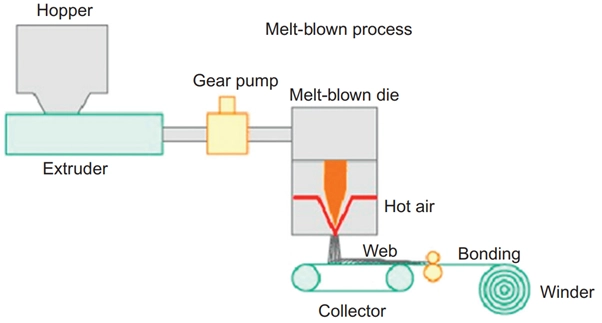
The meltblown process is recognized as one of the meltspun techniques. In this process, molten polymers are utilized, which are transformed into fibers and deposited onto a surface or collector.
As illustrated in Figure 1, the polymer, in the form of powder, granules, or polymer chips, is fed from a hopper into an extrusion chamber where it is heated and melted. The molten polymer is then transported through a gear pump and subsequently filtered to remove impurities or unmolten particles before being fed into the spinning block. The polymer exits the spinning block or spinneret through thousands of micron-scale holes, where the formed fibers are stretched, cooled, and randomly deposited onto a moving conveyor belt, resulting in a non-woven web structure. The three-dimensional structure produced by this process imparts specific characteristics to the filters, such as high permeability and superior particle retention capabilities.
To further cool and stretch the fibers, a stream of hot air is introduced obliquely to the fibers. This interaction between the air and the fibers enhances the stretching of the fibers compared to the spunbond process. Consequently, meltblown fibers are significantly thinner than spunbond fibers, and the final product—the meltblown web—is softer and more delicate.
The following features have been identified as characteristics of meltblown webs:
The fibers in these filters typically exist at the micrometer and nanometer scales, enabling them to filter extremely fine particles, including viruses and bacteria. The fibers are continuous in length, with diameters ranging from 0.5 to 30 microns and variation spans between 2 to 7 microns. Microfibers provide a high surface area, which is essential for excellent insulation and effective filtration properties.
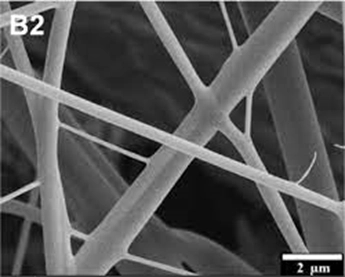
The fibers possess a smooth texture and appear circular in cross-section. The diameter of the fibers varies along the length of a single fiber. Additionally, the fibers may exhibit branching, as illustrated in Figure 2. The exact cause of this branching is not definitively understood; however, it is attributed to the complexities of airflow and fiber extrusion as they approach the collector plate.
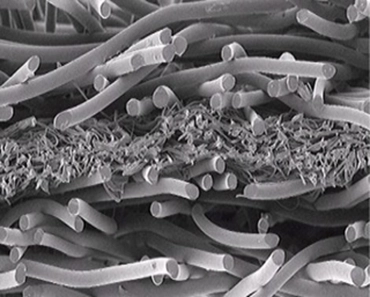
The orientation of the fibers is random, and their strength ranges from low to medium. However, they possess a high surface cover factor (Figure 3). Meltblown webs derive their strength from mechanical interlocking and frictional forces.
Most meltblown webs exhibit layered structures, with the base weight increasing as the number of layers increases. The basis weights vary between 8 to 350 grams per square meter, typically ranging from 20 to 200 grams per square meter.
Due to the porous fibrous structure, meltblown filters offer high permeability for the passage of air and liquids. Owing to their unique structural design, these filters can retain a substantial number of pollutants. Some meltblown filters are electrostatically charged, a feature that enhances their ability to capture airborne particulate matter

In most filter applications, meltblown webs are utilized as part of a composite structure in combination with spunbond or paper webs. Figure 4 illustrates an SEM image of the cross-section of a spunbond-meltblown-spunbond composite layer. However, this is not always the case. Lydall offers a 100% polypropylene meltblown filter media under the commercial name LYPORE® MB. This media is available in both calendared and uncalendared versions
Electrets are dielectric materials that retain an external electric field in the absence of an applied electric field. In air filtration applications, the use of electrets can significantly enhance primary filtration efficiency and reduce pressure drop, as these materials effectively capture airborne particles through their electrostatic attraction. Films, fibers, and non-woven web structures are among the materials that can be converted into electrets.
Electrets are categorized into two distinct types: space charge electrets and dipole electrets.
A notable example of a common method for creating electrets is detailed in United States Patent No. 5,401,446, titled “Method and Apparatus for Electrostatic Charging of a Web or Film.” This patent is not limited to meltblown fibers but is applicable to any material in the form of a web or film. The described device facilitates “cold” charging of the web, meaning the web is charged without the application of heat or stretching. The patent outlines two primary configurations:
In the first configuration, the moving web is wrapped in an S-shape around two charged drums. As the web contacts each drum, it passes through a charged rod positioned on the opposite side of the drum. According to the invention, the drums are negatively charged, while the rods are positively charged. The charging device generates electric fields ranging from 1 to 12 kilovolts per centimeter (kV/cm). When the web moves around the first drum, the side in contact with the drum becomes positively charged, and the side facing the rod becomes negatively charged. As the web continues to move in an S-shape around the second drum and passes by the second charged rod, the charges reverse. Consequently, the side of the web that was positively charged upon contact with the first drum becomes negatively charged upon contacting the second drum, and vice versa for the opposite side of the web.
This method ensures that both sides of the web acquire opposite charges, enhancing the electret properties and, consequently, the filtration efficiency of the meltblown fibers. The ability to charge the web without heat and stretching preserves the delicate fibrous structure of meltblown media, maintaining their high surface area and fine pore structure essential for effective filtration.
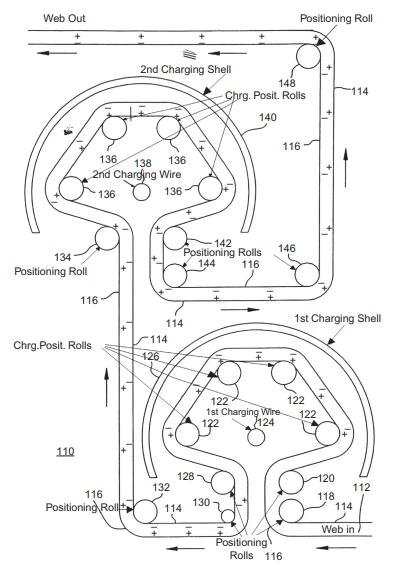
In the second configuration, the web is wrapped in an S-shape around two sets of four charging rolls, as depicted in Figure 5. Instead of charged drums, there are charged shells that cover the web as it passes through the charge positioning rolls. The charging wires are positioned on the opposite side of the web and approximately in the middle of the charge positioning rolls. According to the patent, it is assumed that the shells are positively charged while the wires carry a negative charge. Similar to the first configuration of this invention, each side of the web is sequentially exposed to negative and then positive charges, or vice versa.
The patent states that alternating the polarity of the charges on each side of the web enhances the charge density of the web and extends the charge lifetime within the web. The patent specifies that the polymer used in the web must be non-conductive. Polymers such as polypropylene, polyethylene, polyester, low-density polyethylene, polybutylene terephthalate, polycarbonate, poly(chlorotrifluoroethylene), and poly(cyclohexylidene dimethylene terephthalate) all fall into this category. Additionally, this method is suitable for charging composite web structures that include both conductive and non-conductive fibers. Polyolefin blends with a small amount of acrylic acid added are capable of retaining their charge for longer than expected.
The patent provides data indicating the effectiveness of the corona discharge technique on filtration performance and charge stability over time. Table 1 presents examples of filtration results for several materials that were charged according to the shell charging configuration. The tests were conducted using the TSI filtration test device model 8110 and NaCl aerosol. Filtration efficiency is defined as follows:
filtration efficiency = (100 – P)
where P is the percentage of particle penetration through the filter media.
The term QF in the last column of Table 1 is an index of filtration quality that correlates filtration penetration and pressure drop. This index is calculated as follows:
QF = ln [1/P] / Δp
where ΔP represents the pressure drop across the filtration material.
It is worth noting that the higher the QF value, the better the quality of the material. A comparison of filtration efficiency before and after charging indicates that charging leads to a significant improvement in filtration performance.

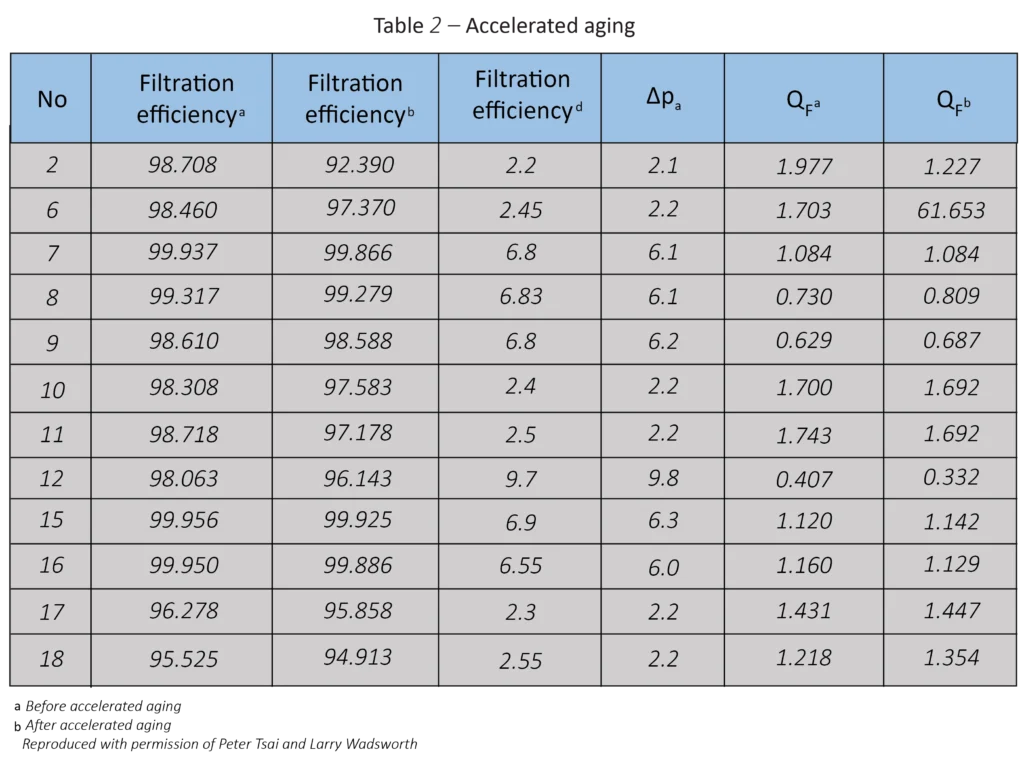
Table 2 illustrates the impact of aging on the electrostatic filtration performance of several materials. Aging was accelerated by exposing the webs to a temperature of 137°C for 10 minutes. The results demonstrate that accelerated aging caused only a minor reduction in filtration efficiency and the quality factor (QF).
Meltblown filters find applications across various industries, including:
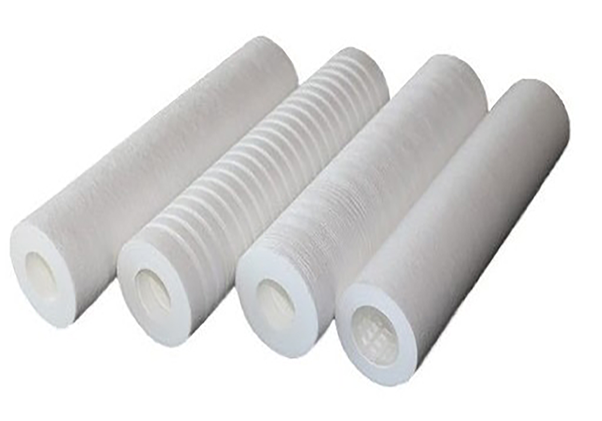
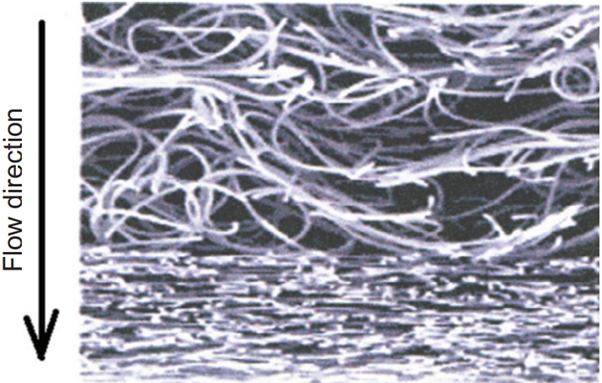
One of the applications of meltblown non-woven materials is in the production of filters with graded pore structures—a filtration medium composed of two or more layers, where each successive layer is more efficient than the previous one. These structures are designed to provide different modes of separation within a single filtration environment. Each layer has a distinct filtration capacity and efficiency, ensuring that as fluids and contaminants pass through the filter media, each subsequent layer delivers a higher level of efficiency in removing smaller particles.
Figure 7 illustrates a cross-sectional view of a gradient-density filter medium used in liquid bag filtration applications. The variation in density facilitates a form of depth filtration, wherein larger particles are captured on the less dense upstream surface, and finer particles are removed within the denser interior layers of the filter medium.
With the rise in air pollution and the spread of infectious diseases, meltblown filters play a crucial role in improving quality of life and reducing health risks. However, challenges such as high production costs and limited resistance to harsh environmental conditions highlight the need for further research and advancements in manufacturing technologies. Moreover, with new developments in nanomaterials and filtration technologies, meltblown filters are expected to enter the market in the future with enhanced efficiency and performance characteristics.
Due to their unique structure and high filtration efficiency, meltblown filters are among the most essential tools for particle separation and filtration in various industries. From medical and industrial applications to water purification and the food industry, these filters have a significant impact on improving air, water, and product quality. Despite certain limitations, they remain an ideal choice for removing micron- and nanoscale particles. With advancements in production technologies, a promising and practical future for these filters is anticipated.
[1] Tsai, P.P., Schreuder-Gibson, H., & Gibson, P. (2002). “Different Types of Electrostatic Forces and the Applications in Filter Media”. Journal of Electrostatics, 54(3-4), 333-341.
[2] Wang, C., Otani, Y. (2013). “Removal of Nanoparticles from Gas Streams by Fibrous Filters: A Review”. Industrial & Engineering Chemistry Research, 52(1), 5-17.
[3] Subrenat, A., Leclerc, J.P., Courteille, F., & Le Cloirec, P. (2001). “Removal of Pollutants on Fibrous Filters by Adsorption and Photocatalysis”. Environmental Science and Technology, 35(1), 50-55.
Author: Amin Forouzan

 Save the post
 Projects: