

The 6th National Filtration Conference, with the central theme of “Filtration in the Petrochemical Industry,” was held on April 22–23, 2025, at the Isfahan Science and Technology Town (ISTT). This scientific and industry-oriented event was organized with the active participation of prominent national organizations such as the Persian Gulf Holding Company, the National Iranian Oil Company (NIOC), the National Iranian Gas Company (NIGC), the Ministry of Energy, the Vice-Presidency for Science, Technology and Knowledge-Based Economy, and various leading industrial sectors across the country.
On the opening day, Mr. Mohammad Ebrahimiān, Executive Secretary of the Conference, emphasized the critical need for pollutant control and energy management in Iran’s industrial sectors. He highlighted that the primary objectives of the event were to explore practical solutions for energy imbalance, energy consumption optimization, pollution control, and other challenges faced by the petrochemical industry.

Dr. Mehdi Abtahi, President of the Isfahan Science and Technology Town (ISTT), also addressed the audience during the opening ceremony. He emphasized the significance of filtration technologies and stated that air pollution in Isfahan is an engineering challenge that can be effectively addressed. He further noted that hosting such conferences benefits industrial sectors by supporting the optimization of their operations and enhancing environmental performance.

Mohammad Asadnezhad, Deputy Director of the Technical Production Office at the Thermal Power Plants Holding Company (TPPH), underscored the pivotal role of specialized laboratories in ensuring filtration quality. He stated, “The only filtration laboratory we recognize and approve is the Filtration Laboratory at Isfahan Science and Technology Town (ISTT).”
Asadnezhad further explained that, considering the average electricity consumption of a rural household is approximately 50 kilowatt-hours, an increase of just one megawatt in power generation—enabled by the use of optimized, standard filtration systems—can supply the electricity needs of about 1,000 rural households in northwestern Iran and approximately 400 households in the southern regions.
He emphasized that, under the current conditions of national energy imbalance, improving the efficiency of power generation through advanced filtration is not just beneficial but essential. This, he noted, is only achievable through the “rigorous evaluation and precise testing of filters in specialized laboratories.”

Ebrahim Mohseni, Managing Director of Isfahan Gas Company, highlighted the legacy of the National Filtration Conference, noting that the inaugural event was held in 2016. He emphasized that the technical achievements of these conferences, such as the establishment of a “National Reference Filtration Laboratory” and the revision of the IGS-M-PM-111 standard, have played a critical role in ensuring filtration quality across industries.
Warning about the severe and sometimes irreversible consequences of improper filtration—including blocked burner nozzles and damage to transmission pipelines—he stated: “The presence of a specialized filtration laboratory at the Isfahan Science and Technology Town (ISTT) can help prevent many of these issues.”
Mohseni further pointed out that Iran, as the holder of the world’s second-largest natural gas reserves and an extensive transmission network, stands to gain significantly from even a 1% improvement in filtration efficiency. Such optimization, he noted, could have a substantial impact on national energy security and sustainability.

Mojtaba Saadatpour, Chair of the National Filtration Conference and Head of the Specialized Filtration Laboratory at the Isfahan Science and Technology Town (ISTT), emphasized the critical importance of selecting high-quality filters. He noted that the effectiveness of filtration systems cannot be accurately assessed through field testing alone, and without certified laboratory validation, systems may incur irreparable operational and financial damages.
He further explained that the Specialized Filtration Laboratory was established with the mission of “preserving quality and reducing the costs associated with functional assessment of filters.” Today, he added, the lab is recognized as a trusted scientific and industrial reference center for filtration testing and evaluation in Iran.

Ali Shomali, Head of Upstream and Downstream Product Development at Persian Gulf Petrochemical Industries Company (PGPIC), delivered a keynote speech at the National Filtration Conference, where he outlined the group’s strategic roadmap for innovation and localization of essential technologies within the petrochemical sector.
Describing PGPIC as the largest petrochemical holding in Iran—with 18 production subsidiaries, 17 investment and service companies, and 23 development projects—Shomali stated: “Without innovation, the industry is destined to perish.” He noted that a wide range of critical equipment, chemical inputs, and consumables used in petrochemical plants have been successfully localized through the holding’s sustained support for research and technological development.
Shomali went on to explain that PGPIC conducts an annual review of its technological needs, gathering input from approximately 30 operational and development-phase petrochemical companies. These needs are compiled by the holding’s Research and Technology Department and published on the company’s internal platform. Knowledge-based and high-tech enterprises are encouraged to review and respond to these challenges, thereby contributing to the national effort of technology localization.
He also announced the launch of a Corporate Venture Capital (CVC) fund by PGPIC. The fund is designed to absorb production-related risks and support knowledge-based companies in their R&D and localization efforts to meet the petrochemical sector’s evolving demands.
Addressing the role of filtration, Shomali emphasized its crucial importance in the petrochemical industry. “Proper, standard-compliant filtration ensures equipment reliability, environmental protection, and operational safety,” he said. “It also contributes directly to adherence with HSE standards and safeguards the health and safety of personnel.”
He added that PGPIC is actively seeking to localize advanced filters using specialized technologies, including nanotechnology, and welcomes innovative proposals for the design, manufacturing, and standardization of filtration systems.
Shomali further announced that PGPIC’s Strategy and Infrastructure Division for Product Development, Technology, and Innovation is planning to organize technology tours for R&D and localization managers across the petrochemical sector. These tours will include site visits to companies based in science and technology parks—such as the Isfahan Science and Technology Town (ISTT)—with the goal of fostering collaboration, encouraging knowledge exchange, and strengthening linkages between the industrial and academic/research communities.

Saeed Khademi, a member of the National Elites Foundation and an active professional in the oil, gas, and petrochemical industries, delivered a specialized presentation titled “Principles and Concepts of Filtration with a Focus on the National Challenge of Coalescer Filter Underperformance,” in which he thoroughly examined the causes of inefficiency in coalescer filters within the gas industry. He emphasized that the improper selection of gas-liquid separation equipment leads to problems such as solution foaming, equipment corrosion, product quality degradation, and increased operational costs. In his presentation, he highlighted the necessity of proper design, the use of pre-filtration, and the control of parameters such as liquid loading and flow velocity in coalescer equipment.
Drawing on field data and practical experience, Khademi demonstrated that poor coalescer performance in refineries and gas processing units not only causes disruptions in the operation of critical equipment such as compressors and adsorption beds but also results in reduced efficiency, increased energy consumption, and frequent operational shutdowns. He proposed solutions such as reducing the heavy hydrocarbon load entering the filter, using filters with a high surface contact area, and implementing staged separation design as effective measures to extend equipment lifespan and improve the quality of the output gas.

Additionally, a specialized panel titled “Challenges and Needs of Filtration and Separation in the Petrochemical Industry” was held. This panel was organized to identify operational issues, technological needs, and pathways for the localization of filtration solutions in the petrochemical sector. The presence of senior representatives from the Persian Gulf Holding, National Iranian Oil and Gas Company, Ministry of Energy, and the Vice-Presidency for Science and Technology made this session one of the most significant parts of the first day.
In this specialized meeting, Ali Shomali, Head of Upstream and Downstream Product Development at Persian Gulf Holding; Saeed Khademi, member of the National Elites Foundation and an active professional in the oil, gas, and petrochemical industries; Saeed Davoodi, Head of Process Engineering at Mobin Petrochemical Company; and Engineer Zamani, Head of Localization at Nouri Petrochemical Company, representing the largest players in the country’s petrochemical industry, participated. A close relationship between filter manufacturers and industrial consumers was one of the main topics of this panel.
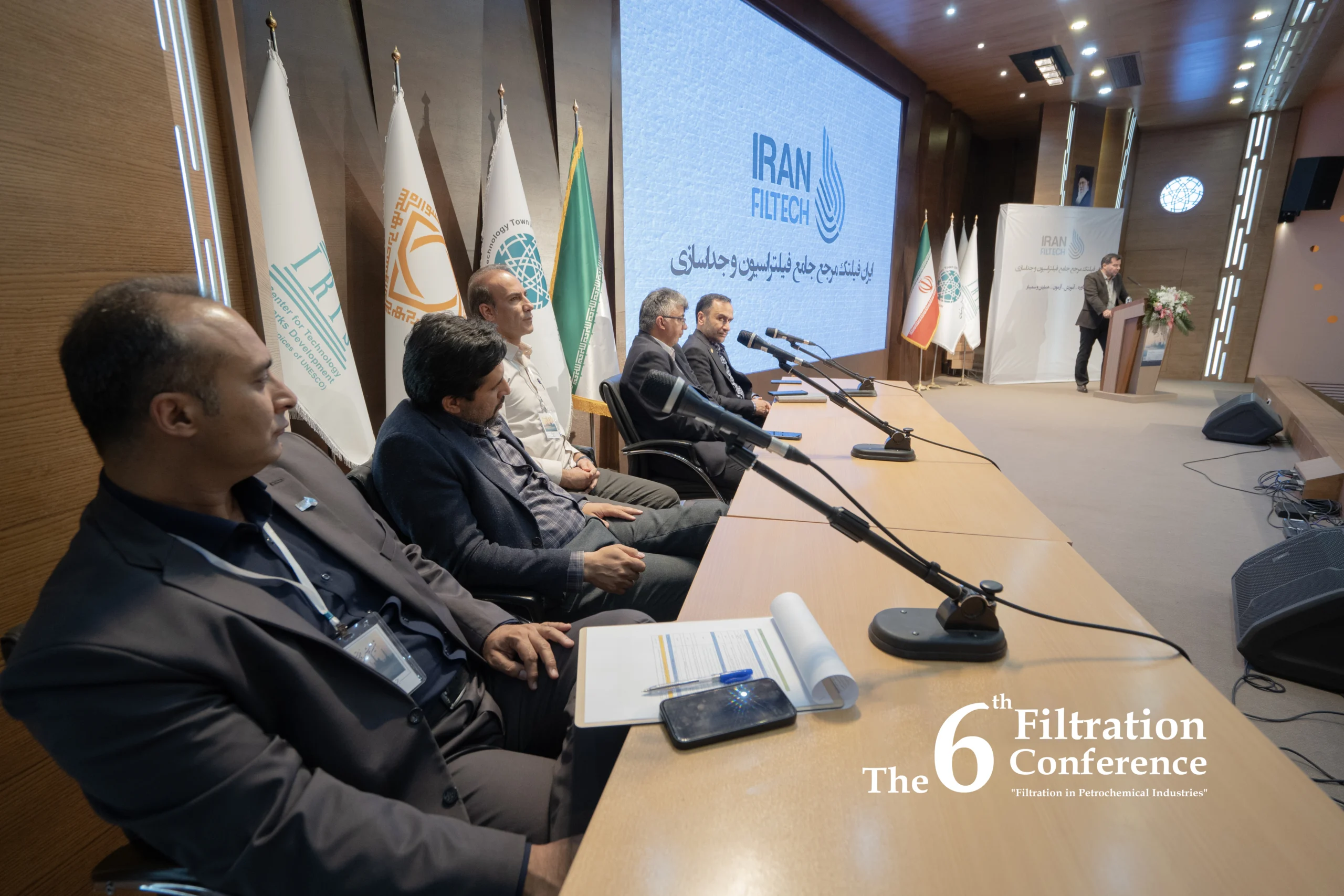
It is worth noting that in this panel, Saeed Davoudi, Technical Director of Mobin Energy Persian Gulf, shared the company’s experiences in the field of filtration and emphasized its role in production stability. He pointed out that over 12,000 industrial filters have been indigenized at Mobin Energy and stated:
“Improper filter design, shortened service life, and lack of transparency in performance testing result in serious damage to equipment and increased operational costs. Our goal is to ensure proper design, accurate evaluation, and continuous interaction between manufacturers and end-users to minimize risks.”
He further added, “In the utility industry, filter quality is directly linked to efficiency, safety, and economic savings. Therefore, we must make use of specialized laboratories for accurate assessments.”
Engineer Zamani, Head of Localization at Nouri Petrochemical Company, also shared practical insights from the company’s experience with filter performance in the NOPC unit. He emphasized the importance of proper filter selection and maintenance, stating:
“Our field assessments show that poor filter performance can lead to pressure drops, reduced efficiency, and damage to critical equipment. Therefore, precise design, selection, and monitoring of filters is a technical and economic necessity.”
He also stressed that developing localized guidelines based on real-world data can significantly enhance the performance of filtration systems in the country’s oil and gas industry.

In the closing sessions of the first day of the conference, two top papers were presented.
Mr. Alireza Faramarzi Babadi delivered his paper titled “Multi-objective Optimization of Influential Variables in Fuel Filters Using Artificial Intelligence” in the main hall of the conference.
The second paper, presented by Mr. Meghdad Kazemi, was titled “Feasibility Study of Producing PET/ZIF-8 Polymeric Media for Particle Removal from Air Flow Compared to HEPA Filter Model H13.”
Alongside the paper presentations, a specialized panel titled “Optimization of Air Filters in Industries” was held with representatives from Sanat Yaran Company. This panel focused on strategies to improve efficiency and extend the lifespan of air filters in industrial environments, addressing challenges and innovative solutions in the field.
The participation and interest shown by representatives of major companies such as Shazand Petrochemical, MAPNA Group, and Abadan Refinery in this session reflected the growing importance of air filtration in ensuring equipment reliability and enhancing the performance of industrial systems.
At the Sixth National Filtration Conference, in addition to scientific presentations, expert panels, and B2B meetings, a side exhibition was also held with the active presence of technology-driven companies. Companies such as Sanat Yaran, Proushat, Ati Andishan Basir, Arvin Sanat, SamTech Ceram, Esfahan Wire Mesh Industries, and Paya Mavad showcased their capabilities and achievements in the oil, gas, and petrochemical sectors. The exhibition offered attendees a valuable opportunity to explore the latest products and technologies in filtration up close and discuss potential areas of collaboration.

 Save the post
 Projects: