


This article focuses on technologies and equipment related to the filtration of large water flows and wastewater treatment that occur in daily flows at medium to large scales, highlighting recent advances in the corresponding technologies. Applications of large-scale water treatment share common characteristics. They all have relatively high flow rates that require high-capacity filters. All of them involve a feed liquid with a relatively low content of suspended solids or the presence of other contaminants, necessitating treatment through clarification processes instead of often more complex solids recovery operations. The low contamination level implies that the system parameters involved in the filtration process will all be relatively mild: a non-corrosive liquid with viscosity and density close to pure water, and a temperature mostly close to ambient.
Water, in any form, as a liquid for drinking, washing and other related uses, as a process input (for example in food and beverage production or pharmaceutical processes), as a utility (mainly in the form of steam) and in Finally, as a waste product from domestic and industrial activities, it needs to be treated before it can be returned to water sources.
The main water cycle starts, of course, with rain falling on the earth, most of it making its way to the sea by means of rivers, although the journey may be delayed by lakes. Water derived from the river/lake system is called surface water. The balance of the rain soaks into the ground and becomes held in underground aquifers (porous rock strata), from which it may eventually emerge as springs, if it has not been abstracted as groundwater. From a purification point of view, the two types of water have very different needs. Groundwater is essentially clean of suspended material, by virtue of its prolonged filtration by porous rock, but it is heavily loaded with dissolved matter (hard water) of many different kinds, and has the mineral taste accepted by many as the taste of pure water. Surface water, by contrast, has very little in the way of dissolved salts (soft water), but is frequently loaded with fine suspended solids and colloidal matter, with a lot of dissolved organic material, which gives the water a marked brown color and an unpleasant taste.
Water abstracted for domestic or industrial purposes will come from whichever source is the most convenient, which usually means the nearest, so the raw water quality will be decided by the geology at the point of abstraction (for example, mainly soft from the impervious rocks of northern and western Great Britain, and mainly hard from the limestone hills of south-eastern Great Britain). The treatment processes required to convert raw water to fresh are thus largely dictated by the nature of the source of the raw water. That is why flexible products that have great versatility in all areas of a treatment plant are being offered.
These treatment processes involve the purification of the raw water to a state fit to drink, which state is also good enough for many other domestic, commercial, and industrial uses. Some end uses require a higher degree of purity, but the final result of the use of standard or high-purity water is the same, namely the production of a large quantity of contaminated wastewater, sometimes highly contaminated. This then leads to the second major part of the water cycle, the need to treat the wastewaters adequately to permit them to be returned to the earth, in rivers, lakes, or seas.
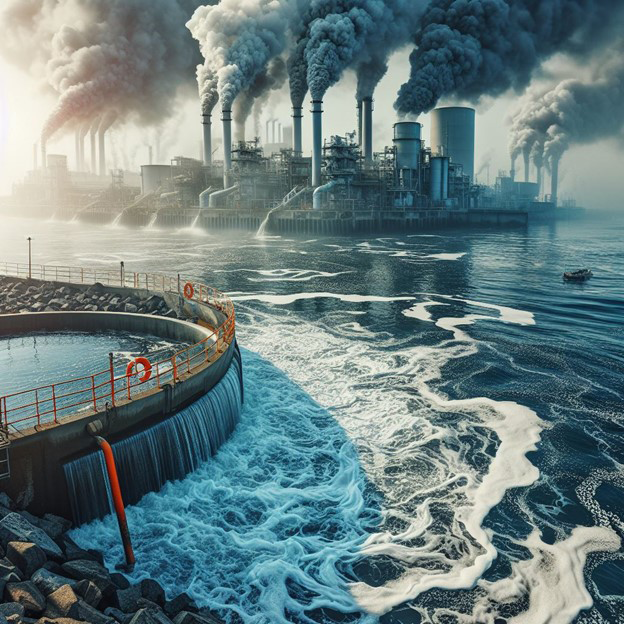
This describes the main water cycle, relying on ‘fresh’ water sources, but the great majority of the earth’s water is in the sea, which is far too salty for human or animal use, or for irrigation, and so must be desalted before it can be used for drinking or irrigation. The desalination of salty waters is a well-established technique, but is an expensive one and very energy-intensive. It is thus employed either where energy is cheap or there are no other sources of water. The cost of production from salt water is so much greater than that from freshwater that the incentive for water conservation is correspondingly greater, and the waste treatment component of the water cycle is of lesser importance in the total expenditure.
The global water situation is steadily worsening because of polluted groundwater, rivers and lakes, over-enriched and dirty seas, and water shortages within the growing populations of the less developed world. Water is, of course, essential if humans, animals, and plants are to survive, and a major problem is that most people in the developed world take both hot and cold water for granted, and often squander it without reflection.
Human consumes less than 1% of fresh water on earth. Most of the fresh water is trapped in ice layers, glaciers, and mountains. Freshwater makes up 2.6% of the earth’s water and 97.4% of it is salt water. 70% of fresh water is used in irrigation, 10% for domestic use, and 20% in various industries. About 1.3 billion of the world’s population does not have access to safe drinking water. Every year, a large number of people (about 1.8 million people) die due to diarrheal diseases caused by the use of unclean and unhealthy water. The world population is increasing rapidly and it is expected to increase to 3 billion people in 2050. About 2.7 billion people live in developing countries where the economic effects of unsafe water use are devastating.
There is hardly any raw water treatment in the less developed world, and the standard of treatment is low in many other areas. Suitable technology does exist to achieve a satisfactory standard of water production, and, with the advent of greater political awareness of the problems and stricter environmental legislation, there are many opportunities to improve the world’s water supply.
The objective of the filtration processes used in water treatment is mainly to achieve the separation of solid particles that are suspended in the water to the extent, perhaps, of 0.5% by weight or as little as 10 mg/l (10 ppm), particles that are as large as grit or sand (say 1 mm in diameter or more) or as small as colloidal organic materials, or pathogens such as bacteria or viruses (say 0.1 μm or less).
The types of equipment used to achieve these separations are relatively few in broad classes, although extremely varied in physical embodiment.
There is no better way to start water purification than using strainers, whose function is to completely protect downstream equipment or processes from the impact of impurities that may clog narrow passages or passages. slow or damage wear-sensitive surfaces. These filters, also known as coarse filters or microfilters, are required to filter incoming streams – freshwater or wastewater – to remove large particles accumulated in the stream, often in the form of a rotating drum or array. They are a circle of wire nets that are closed at one end and rotate on a horizontal or nearly horizontal axis in the screening and washing areas, and are often specifically designed for the channels of a water treatment plant, whose schematic is shown in Figure 2. The drum is usually covered with a wire mesh with a mesh size of 25 µm, although after cake formation, particles as small as 3 µm can be collected. This is a very effective pre-filter for high-flow conditions.
The coarsest water filtration is undertaken by strainers, either the in-line or larger units. The in-line units can often be blown clear of collected solids (otherwise having to be dismantled for cleaning), while the larger ones run continuously, with collected solids washed or scraped off the collecting surface. The filtration medium is usually a perforated metal plate or piece of wire mesh, in the form of a cylinder for the in-line units, or a large plate or wire screen for the continuous strainers.

Screens used for large water flows may have arrays of vertical rods that can be adjusted from fine to coarse filters by adjusting the gap width. Therefore, it can be adjusted for any application and will have low maintenance needs compared to the rotating drum array. The minimum width of the gap for the samples available in the market is 5 mm and the maximum is 100 mm. An example of these pages is shown in Figure 3.

The combination unit is used for mechanical pretreatment in municipal and industrial wastewater treatment plants. Effluent can be fed to the unit by gravity or pump power. Then, the effluent is directed to a plate that is moving in a stepwise manner, where mechanical separation is done. Finally, in the washing part, the screens are washed, dewatering and residual materials are pressed, and the sand that is not separated by the filter screen is separated in the sand trap. An aeration system as well as a scraper system can be added to the machine to remove fat. The sand is transported by a lower conveyor to a discharge conveyor or a sand pump. The schematic of this system and the real unit are shown in Figures 4 and 5, respectively.


A new technology in this section includes the use of several rotating filter discs and fabric media. The water to be filtered flows to the drum through the inlet channel and then flows to the filter disk section through the openings of the drum and passes through the filter environment with the force of gravity or the pump. The separated suspended solids are collected inside the filter cloth. When the water level inside the filter drum rises to a pre-set point, the drum starts rotating through the rotor and the backwashing of the filter media starts, and thus continuous washing during filtration is possible. This design provides high-efficiency filtration and a high flow rate in minimum space. Figure 6 shows the schematic of this process.
Installing replaceable velvet fabric on the original fabric media on both sides of the disc provides a combination of smoothness and depth filtration, resulting in high-efficiency filtration. This technique provides separation of phosphorus from water without the need for electrolytes.

Another innovation in this field is new filters called belt filters, which can be a good alternative to rotating roller filter systems, albeit on a small scale. This type of filter is an automatic and self-cleaning belt filter that removes particles from water in an economical and space-saving way. The belt filter is interchangeable with the standard primary filtration of urban sewage and sedimentation processes, although on a smaller scale, and due to its effectiveness, it provides up to 50% savings in investment. This filter can also be used in fish farms. Another advantage is that it delivers very dry sludge that does not require further processing to recover water.
In this type of filter, untreated water is directed into the filter and when the water passes through the belt filter, the particles are separated. The belt plate rotates when it needs to be cleaned. The belt is generally cleaned with a brush and then high pressure washed, which is both cheaper and, in many ways, better than air cleaning. The particles separated by the brush are transferred from the filter to the press, which dries the sludge in a large amount. Wastewater is discharged separately from the filter and can normally be returned to the incoming water. The schematic of this type of filter is shown in Figure 7.

One of the most widely used and still the main type of filter that is used to clarify large flows of water entering the treatment plant is the deep bed (or sand) filter. For more than 100 years, this has been the basic method of purifying fresh water to make it safe to drink. Typically, such sand filters are of the gravity type, but up-flow filters are also used where higher flow rates are required or where high-water turbidity makes conventional downflow sand filters impractical. to be the schematics of both types of filters are shown in Figure 8.
Metals and their compounds persist in the environment and can be a serious problem in raw water treatment, especially from groundwater sources or surface water with a high proportion of agricultural run-off content. They may accumulate in organisms, particularly those near the top of the food chain, and cause a range of toxic effects. Metallic ions present in raw water arise from the leaching of minerals in the ground, from industrial effluents and chemical processes, and from leachates from landfill sites and contaminated land.
Conventional downflow sand filters are effective for liquid-solid separation at flow rates up to about 15 m3 /h.m2 of filter area, although higher-rate downflow filters are available. With proper selection of filter media, gelatinous as well as granular suspended matter can be filtered out, without a rapid differential pressure build-up.
The bed is cleaned by a reverse, upward flow of filtrate water, sufficient to expand and fluidize the granules of the bed. When sufficient backwash liquid has passed through the bed, the bed particles settle back into place under the influence of gravity. If the particles are all of the same material, then the largest ones will settle at the bottom of the bed and the smallest ones at the top, which is the wrong way round as far as filtration is concerned, which is best achieved under downflow conditions by having the largest pores (created by the largest particles) at the top of the bed, first meeting the incoming raw water.
Typical filter media for the downflow filter consist of selected silica sands, and coal or anthracite, which are tough inert solids, available in a range of particle sizes. One solution to the problem of matching the pore sizes in the bed is to use layers of different solids, with different densities. If the denser material also has the smallest particle size, then the layers will resettle after backwashing with the finest at the bottom and the coarsest on top.
Materials for use in multi-layer downflow beds include anthracite, with a specific gravity of 1.4, flint sand (2.65) and garnet (3.83). Magnetite (4.9) can be used for a fourth layer if necessary.
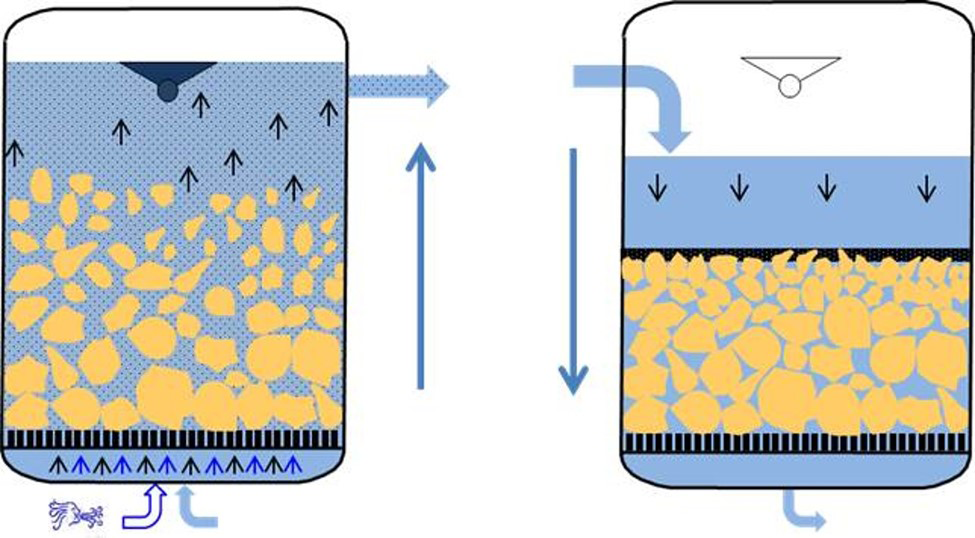
A two-stage multi-media filtering system, shown in Figure 9 has been developed to treat turbid surface waters coming from rivers, lakes, reservoirs or the sea, but which are low in colour, iron and manganese. Whilst operational, oxidizing and coagulant solutions are injected into the primary (upper) vessel, and a further coagulant is also injected prior to the second (lower) vessel. The primary filter medium comprises anthracite, supported by a layer of silica sand. The secondary filter medium comprises a medium-sized layer of silica sand, supported by the final polishing layer of garnet or barium sulphate. The system has four programmable self-cleaning steps, using the normal backwash principle.

The alternative approach to match flow direction with pore size is to undertake the filtration in upwards flow. With an upflow sand filter, flow is from the bottom through to the top of the bed. The result is that the entire bed depth is utilized to trap solids, with the fine top layer acting as the final cleanup zone. This gives a suspended solids capacity of 29 to 48 kg/m2, depending on the density of the suspended matter, a greater capacity per unit of surface area than in a conventional downflow filter. A bed stabilizer is necessary at the top of the bed, to keep it in place during the high on-stream flow rates, to take full advantage of the bed’s capacity to retain trapped solids. The bed is cleaned by an upward flow of backwash liquid, but the bed is expanded by air agitation before washing, to achieve maximum cleaning efficiency. This mode of operation allows the up-flow filter to handle turbid waters at high flow rates with longer cycle lengths while ensuring good cleaning cycles.
The bulk filtration units so far described operate under gravity, because they involve very large quantities of raw water and, in consequence, are very large units to cope with the flow (Figure 10). A possible alternative approach is to pressurize the containing vessel and pump the raw water into the filter, thus increasing the pressure differential across it and thereby increasing the flow rate. This is a much more expensive process and tends to be used for small demand/high-quality treatments, which may involve chemical processes as much as filtration.
Deep bed filters are constantly being developed, such as the use of advanced materials that are highly resistant to sand abrasion, which means longer equipment life and easier maintenance. In addition, the speed of sand cleaning (sand/water ratio) can be optimized with the help of two adjustable overflows with a specially designed washing box, which minimizes losses during backwashing. There is also the possibility of simple expansion for biological treatment in these filters. In the following, the progress made in this field is stated.

Figure 11 shows a pressure vessel filter, operating in upflow mode, and developed for the removal of dissolved iron from water supplies. The fi ter medium takes the form of a bed of catalysed manganese dioxide in granular form, approximately 1 m deep. This medium has the ability to cause dissolved iron to react with the oxygen present in the water to form insoluble iron oxides, which will precipitate and be retained by the bed. Cleaning is then undertaken by a high-velocity backwash process which fluidizes the bed medium and removes the precipitated iron.

The major development of the deep-bed filter has been to allow the bed material to move continuously down through the filter vessel, and then to be carried back up to the top of the bed, through a cleansing zone. Manufacturers have concentrated on the development of the moving bed filter, which provides better cleansing of the bed and does not have to be shut down for backwashing. It is thus a truly continuously operating filter. Figure 12 shows an example of a typical continuous self-cleaning sand filter. It has no mechanical moving parts yet it is possible to obtain feed flow rates of up to 25 m3/h per square meter of filtering area.
The main structure of the filter is a cylindrical tank with a conical bottom. In operation, the raw water is fed in (1) where an inlet system, and (2) evenly distributes the flow into the filter bed. This bed is made up of sand of a predetermin grain size, selected according to the nature and quantity of suspended solids in the raw water. The water flows through the sand bed and leaves the filter at the overflow weir (5). The sand bed moves continuously downwards, being sucked from the bottom by an airlift pump (6), which carries the dirty sand upward to the top of the filter into the sand washer (7).

The washed sand falls back into the fi lter through the chamber (8). The pressure drop across the filter remains at a constant low value by virtue of the continuous washing process that keeps the filter bed clean. The heart of the system is the sand washer, which, via the airlift, receives a concentrated mixture of sand, water and dirt particles; the dirt is separated from the sand by flotation due to the action of micro air bubbles generated at the air diffuser (9). The sand washer is designed to clean each grain of sand by scouring. The dirt particles are floated upward by the air bubble action and leave the filter over the sludge weir (10), and are carried away by some of the wash water. This rejected water is a small fraction of the total water fed to the filter and is returned to the filter inlet after the sludge is dewatered.
It is recommended that a filter screen be used ahead of and in conjunction with filters of this type. Continuous self-cleaning filters of this kind are considered to be one of the most reliable types of bulk water filter available, with low plant costs and high clarification efficiencies. A set of full-scale moving bed filters and a schematic of one unit are shown in Figures 13 and 14, respectively.
Continuous operation has several advantages over conventional backwash sand filters. In conventional sand filters, as the particles increase in drop, the sand must be cleaned by backwashing before continuing the operation. Although the backwash time is short, it reduces the effective operation time. Ever since continuous sand filter technology was developed, it became possible to achieve an optimal solution to the need for a continuous water and wastewater treatment process while providing consistent filter quality even at high flows. Other advantages of this system include: no need for washing pumps, no need for rinsing tank and tank for washing water and no need for automatic valves for backwashing.


In applications where the water contains dissolved contaminants that cannot be removed by contact filtration or biofiltration, activated carbon is ideal for removal by surface adsorption. Activated carbon is one of the strongest adsorbents in the world and can be used to remove a wide range of pollutants from industrial and urban wastewater as well as from surface and underground water in the production of drinking water. Carbon filters are often installed directly after sand filters. Then the water can be transferred to the carbon filters through gravity. Carbon filters can be used for drinking water or raw water applications mainly to remove manganese and improve the taste and smell of water. Figure 15 shows the real image of a carbon filter.

Much thought is currently being given to the immediate collection of rainwater and its use for low grade fresh water applications, such as toilet flushing, garden irrigation and so on. An automatic system that collects rain and wastewater from roofs and pavements in and around a building, stores it in a tank and then filters it to produce a pure supply is shown in Figure 16. The system can remove all organic compounds including oil, grease, and detergents.

A similar approach is now being adopted to the recycling of so-called ‘grey water’, which is all of the water going to the domestic drain except that from toilet flushing. This includes bath and shower water, and laundry waste. It might also include kitchen sink drainage, provided that this has no toxic content.
The main problems with rain and grey water recycle are public acceptance, and the cost of very different plumbing circuits, to take two grades of water around the house or apartment building.
The hyperbolic cooling tower is one of the most attractive sights wherever the subject of industry is discussed (Figure 17). Its vapor mass, which is thought to be toxic effluent, is a symbol of many destructive environmental effects of industrial activities. Of course, this mass is a sign of heat loss and therefore it should be gradually reduced.
Cooling systems for large power plants (factories, power plants, etc.) are of two types: single-pass and rotary. Single-pass systems are used by large power plants located by the sea or large rivers that take their cooling water, treat it if necessary, use it, and discharge it back where it came from. Circulating systems have a reservoir of water that is used for cooling, then cooled to remove residual heat, and then returned to the water source.

As far as the filtration work is concerned, the cooling water must pass through some kind of heat exchanger, whose main performance is dictated by the clean heat transfer coefficients, but whose actual performance is due to the formation of deposits on the Heat exchange surfaces (some of which are in the form of narrow channels or are inaccessible) are reduced. This is the function of the filtration system, which must be installed before the heat exchangers, to remove suspended matter – animal, plant or mineral – from the cool water.
Cooling water purification is necessary in each of the two types of systems used. In single-pass cooling, the water is of the same quality as the source at the time of harvest, so the treatment process is relatively more extensive. Recirculating systems, on the other hand, must have only a small amount of constituent water (to compensate for water lost to evaporation), but must also remove collected suspended solids from the cooling stream.
The degree of filtration required depends on the amount of water to be treated and the quality of the treated water required to keep the heat transfer surfaces as clean as possible. A strainer is required as an inlet filter before a fine filter such as a deep bed system or a multi-bag filter. If there is a lot of organic or colloidal material in the influent, it may even be necessary to consider ultrafiltration as a final step.
The hot water in the cooling tower pond and accumulated organic matter provide perfect growth conditions for bacteria. The outbreak of diseases related to cooling water systems is a reason for serious concern. The conditions under which the disease can grow in water systems and be transmitted to the environment are diverse and complex. A medium-sized cooling tower can collect between 2 and 3 kilograms of solid matter daily, including dust, engine exhaust, pollen, and insects. Together, these create a biofilm within the system, especially in the low-flow areas of the cooling tower basin, which can act as a food source for bacteria.
Much work is being done to evaluate alternatives to common chemical compounds for biofouling control in cooling systems. Alternatives such as bromine, ozone, ultraviolet rays, and pasteurization are all being tested, the effectiveness of which depends on the quality of the circulating water. Accumulation of inorganic and organic debris in circulating water interferes with the activity of chemicals, and filtration has long been recognized as a way to maintain the effectiveness of these chemicals. Modern filter media and membrane systems allow the removal of bacteria and are therefore an important component of the treatment process.
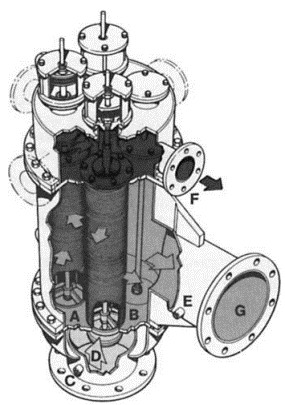
Not all cooling systems are large, and some are well cleaned using self-cleaning units like the one shown in Figure 17. This is a typical example of an effective automatic filter, showing three filter elements (here called pods) being used in parallel. Under normal filter operation, all filter pods are in use and the control system controls the pressure drop. When the pressure drop reaches a predetermined level, the collector rod is rotated by the positioning motor until it is aligned on the first pod. While the remaining pods continue to filter, the backwash valves are opened to allow some of the treated water to wash the first pod. In this way, the filter elements are opened and the pollutants are usually collected in a tank. Each pod in turn is cleaned in this way and finally the backwash valves are closed and the filter returns to full filter mode.
The elements that use this type of filtration system consist of a spiral coil made of stainless steel. The protrusions on the upper surface of the coil guarantee the exact filtration gap up to the required separation degree. Standard grades are usually 12, 25 and 120 microns. During self-cleaning, the liquid flow reverses and the compression of the spring loosens a little. Therefore, the distance between the coil turns is increased and allows contaminants trapped in the coil structure to be removed during backwashing. An automatic bypass valve is usually installed around the filter. This valve is connected to the control system and opens automatically if the filter is blocked by objects that cannot be backwashed.

The filter shown in Figure 18 is a linear, self-cleaning filter that is suitable for filtering industrial water as well as small cooling water installations. When the pressure drop reaches the predetermined limit, the reverse washing of one of the filters starts and the filters are cleaned individually and in order, while the remaining filters continue the filtration operation.
The purpose of water treatment is to remove unwanted substances from water and make it safe for domestic use or suitable for a specific purpose in industry or medical applications. A wide variety of techniques are available to remove contaminants such as fine solids, microorganisms, and some dissolved inorganic and organic substances, or persistent environmental pollutants. The choice of method depends on the quality of the treated water, the cost of the treatment process and the quality standards expected from the treated water. Equipment such as strainers, deep bed filters, pressure filters, moving bed filters and carbon filters are usually used in the water purification process. Depending on the raw water (source) quality scale, some or all of these equipments may be used. Rainwater recycling, which is an easy and environmentally friendly way to reduce water and energy costs, makes the filtration process suitable for many low-hemite applications. The water in the cooling tower is constantly rotating and fine and coarse suspended particles may enter the tower from the environment around this cooling tower. In order to prevent the continuous rotation of such particles, a filtration system is used to separate fine and coarse suspended particles from the circulating water of the cooling tower.
[1] Sutherland, Kenneth S., and George Chase. Filters and filtration handbook. Elsevier, 2011.
[2] Ahmed, Farah Ejaz, Boor Singh Lalia, and Raed Hashaikeh. “A review on electrospinning for membrane fabrication: Challenges and applications.” Desalination 356 (2015): 15-30.
[3] Sutherland, Ken. “Water filtration: Bulk water filtration techniques.” Filtration & separation 45, no. 10 (2008): 17-19.
[4] Luff, Richard, and Brian Clarke. “Water Treatment Guidelines For Use in Emergencies.” (2006).
[5] https://www.nordicwater.com/product/dynadrum/
Author: Amin Forouzan

 Save the post
 Projects: