


How can the performance of a compressor be optimized? What factors contribute to extending its service life? Is lubrication an unavoidable necessity for compressors? And what role does filtration play in a lubrication system?
A properly designed lubrication system not only prevents corrosion and overheating of components but also ensures the efficient and reliable operation of the compressor. Selecting the right lubricant, based on the compressor type and its specific operating conditions, has a significant impact on lubrication quality.
This article explores the various types of oils used in compressors, their characteristics, and the critical role of filtration. Key considerations in selecting appropriate lubricants and the importance of proper lubrication in maintaining compressor performance and reliability are also discussed.
A compressor is a mechanical device designed to increase the pressure of compressible fluids such as gases and vapors. Its operation is based on reducing the volume of the fluid, thereby increasing its pressure. There are various types of compressors, but their primary function remains the same: increasing gas pressure by decreasing its volume.
During operation, metal components inside the compressor move against one another in sliding motion. If these surfaces are not separated by a lubricating film, they wear out quickly and can cause equipment failure. Lubrication creates an oil film between moving parts, significantly reducing friction, extending equipment life, and improving operational efficiency.
Virtually all compressors require lubrication for cooling, sealing, or protecting internal components. The only exceptions include certain static jet compressors and a few oil-free machines that use magnetic or air bearings.
Choosing the right lubricant for a compressor demands a thorough understanding of the parameters that influence its performance. These factors include:
Awareness of these factors enables the selection of an optimal lubricant and helps prevent common issues such as viscosity degradation or chemical reactions between the gas and lubricant.
Proper lubricant selection is essential to ensure compressor health and performance. The first step is consulting the OEM (Original Equipment Manufacturer) guidelines, which typically include recommendations for viscosity and lubricant type.
It’s also important to assess how the compressed gas affects the lubricant. For instance, air compression can lead to higher lubricant temperatures. Hydrocarbon gases tend to dissolve lubricants, reducing their viscosity. Chemically reactive gases such as carbon dioxide and ammonia can alter the lubricant’s properties through chemical interaction.
In addition, environmental factors—including ambient temperature, airborne contaminants, and weather conditions—must be taken into account when choosing a suitable lubricant.
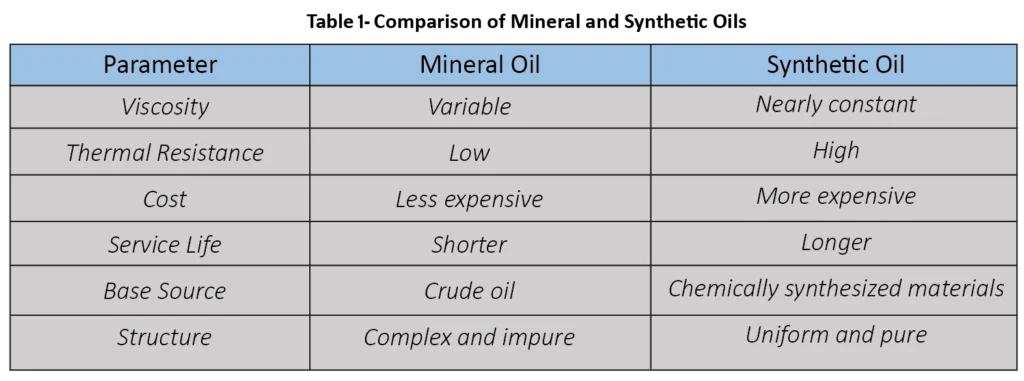
Compressor oils are generally categorized into two main types: mineral oils and synthetic oils.
Mineral oils are derived from crude oil distillation cuts, commonly referred to as lub cuts, and are classified based on boiling point into lighter or heavier fractions. The most significant difference among these fractions lies in their viscosity. Mineral oils include: Paraffinic oils, Naphthenic oils, Aromatic oils
Each of these types exhibits different characteristics and suitability depending on compressor design and operating conditions.
Due to the inherent limitations of mineral-based lubricants, particularly under demanding conditions, synthetic oils have become increasingly important. As compressor designs become more complex—with higher rotational speeds, elevated pressures, and increased operating temperatures—the need for longer lubricant service life and superior performance grows.
Moreover, environmental concerns such as ozone layer depletion and the transition to new-generation refrigerants (which are often incompatible with mineral oils) are key reasons for adopting synthetic lubricants.
These oils are produced under controlled conditions in chemical reactors and demonstrate significantly superior physical and chemical stability compared to mineral-based lubricants. For this reason, most manufacturers of industrial compressors—particularly refrigeration and rotary compressors where the oil is in direct contact with the compressed gas—prefer synthetic oils over mineral oils.
The most common synthetic lubricants include:
Viscosity refers to the lubricant’s resistance to flow and internal molecular friction. It must match the compressor’s operating temperature.
The viscosity index indicates the degree to which a lubricant’s viscosity changes with temperature.
The pour point is the lowest temperature at which a lubricant remains fluid.
If the pour point is too close to the operating temperature, issues may arise:
Vapor pressure reflects the oil’s tendency to evaporate.
The flash point is the lowest temperature at which oil vapors ignite in the presence of a spark.
The fire point is the lowest temperature at which the lubricant produces sufficient vapors to sustain ignition once exposed to a flame under standard conditions.
This is the minimum temperature at which the oil-air mixture ignites spontaneously without an external ignition source.
This value measures a lubricant’s resistance to oxidative degradation.
Selecting a lubricant based on actual operating conditions and OEM recommendations ensures optimal performance and equipment lifespan. An appropriate oil not only improves efficiency but also extends service intervals and overall compressor reliability.
Lubrication systems in compressors are exposed to both internal and external contaminants. Internal contamination includes abrasion particles from moving surfaces, leakage gases, and sludge resulting from oil degradation. Abrasion debris is typically highly abrasive and is predominantly generated during the first 10 to 20 hours of compressor operation. Protecting the system against such contaminants can be achieved by timely oil changes as recommended by the equipment manufacturer or through the use of effective filtration systems.
The formation of black sludge can obstruct oil flow, potentially leading to engine shutdown. Additionally, if seals fail to provide complete sealing, leakage gases—composed of a mixture of exhaust gases and unburned fuel—may enter the system with each engine cycle. While these gases are usually vented out through the crankcase breather, they may react with degraded oil or other contaminants.
The presence of foreign particles in the moving parts of the system can significantly reduce their efficiency. This not only compromises compressor performance but also leads to increased energy consumption. Although all lubrication systems are inherently susceptible to particle contamination, particles with sizes equal to or greater than the oil film thickness pose the greatest risk of damage. Preventing the ingress of such particles is essential to maintaining optimal system performance.
Contamination control of lubricating oil is vital to ensuring the longevity of system components. Unscheduled system shutdowns can lead to increased maintenance costs and significantly lower operational efficiency. For this reason, investing in high-performance industrial oil filtration systems is of critical importance to maintain fluid cleanliness.
Oil filtration is a core component of any maintenance program for lubrication systems. Today, high-efficiency filtration technologies are widely employed in most lubrication-related applications. Advanced filters, with stable performance and extended service life, play a fundamental role in maintaining optimal oil cleanliness. These features not only enhance operational reliability but also reduce maintenance costs and improve productivity across industrial processes.
To remove suspended particles from lubricating oil in compressor systems, a combination of strainers and filters is employed. The oil strainer, usually designed as a coarse mesh screen, is installed at the pump’s suction inlet and is responsible for preventing large particles from entering the pump.
Oil filtration is a key element in ensuring optimal performance and extending the service life of mechanical equipment. Oil filtration systems can be categorized into two main types:
In full-flow systems, the oil filter is placed directly in the main oil circuit between the oil pump and the bearings or distribution points. Since the filter directly affects the oil pressure reaching the bearings, such systems face certain constraints. The filter must be large enough to handle high oil flow rates—typically up to 25 liters per minute.
When the oil is cold, pressure drop across the filter may exceed acceptable limits. Additionally, if the filter becomes clogged due to contaminant buildup, it can cause further pressure reduction in the system. Therefore, filters are usually equipped with bypass valves that activate when the pressure drop reaches approximately 1 bar. These valves automatically close once the oil warms up and its viscosity decreases.
Furthermore, an anti-drainback valve can be employed to prevent oil from draining back to the reservoir when the engine is shut down. This feature ensures that oil reaches the bearings immediately upon engine startup.
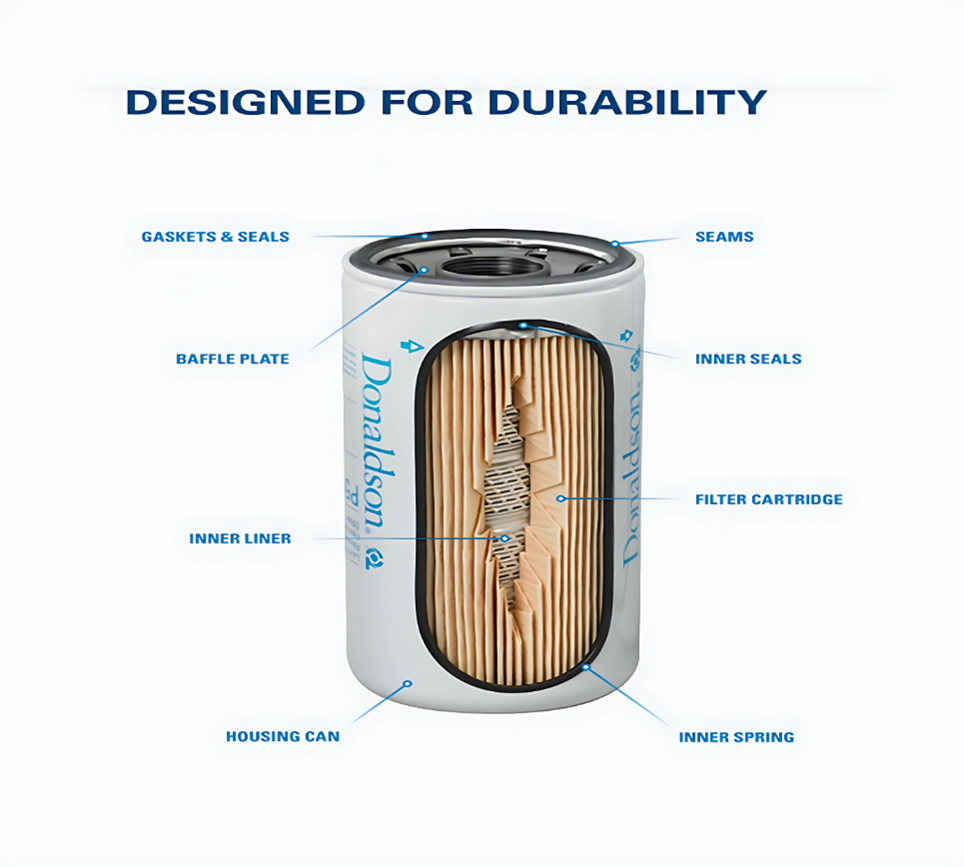
Full-flow oil filters are generally of the surface-type and consist of two primary components: the filter housing and the filter element.

Bypass Filtration
In a bypass filtration system, only a portion of the oil flow passes through the filter, while the remaining oil is returned directly to the reservoir. This configuration maintains the primary oil pressure in the system and helps reduce abrasion on bearings and moving parts, without requiring auxiliary valves.
If the filter becomes clogged, the system automatically redirects the oil flow out of the circuit. It is recommended that the flow rate through the filter be at least 10% of the engine oil flow rate, and the total volume of oil processed should be at least five times the total circulating oil volume. However, this method cannot remove all contaminants in a single pass, and the oil may need to circulate through the system multiple times for complete purification.
These two filtration methods—full-flow and bypass—function complementarily and play a crucial role in ensuring operational efficiency, extending equipment life, and reducing maintenance costs.
In compressor systems, lubricating oil is drawn from the reservoir by pumps and is pressurized to flow through coolers or heaters, depending on operational requirements. The oil also passes through control components such as thermal sensors, which monitor oil temperature during startup and operation. It is then routed through filters and delivered to the machine’s moving parts. During this process, the oil is responsible for lubricating and cooling the compressor’s bearings and gear systems. After fulfilling these functions, the oil returns to the reservoir.
The lubricating oil performs several critical functions in the system:
Given the sensitivity of compressors and the need to maintain optimal performance, each compressor has specific requirements that must be matched with a compatible filter type. Two main filter types are commonly used in compressor systems, which may be installed either as single units or in duplex configurations depending on system design:
These filters are designed to maximize the filtration surface area and are typically single-use elements. The filter media may be made from various materials such as paper, felt, bulk fibers, wound yarn, spunbond fabrics, or synthetic fibers. Among these, synthetic fibers offer notable advantages due to their high resistance to acids and corrosive substances, complete water resistance, and superior mechanical strength.
In some applications, nonwoven elements are used in oil filters. These elements are ideal for demanding industrial systems due to their deep filtration capability, high dirt-holding capacity, and low pressure drop. Pleated nonwoven media are often reinforced with spacers or wire mesh to withstand operational pressures. Structurally, these filters consist of pleated media enclosed in a cylindrical housing, often featuring perforated inner tubes and sometimes an external protective shell, all of which are installed inside a filter housing.
Spin-on oil filters are also a type of cartridge filter, typically featuring a resin-impregnated paper as the filtration medium. In these filters, oil flows from the outside to the inside, and the cleaned oil exits through the central core. Most spin-on filters are equipped with bypass valves, specifically designed to accommodate cold-start conditions. When differential pressure exceeds a set threshold, the bypass valve opens, allowing oil to flow directly over the filter element into the core, thereby maintaining lubrication during startup or filter clogging scenarios.
The simple design and effective performance of spin-on filters have made them widely popular, particularly in automotive applications and compact equipment.
To ensure the reliability and performance of oil filters, a series of standardized tests are recommended. The five core ISO tests for oil filter evaluation include:
ISO 2941, ISO 2942, ISO 2943, ISO 3968, ISO 16889

To remove the filter, the associated bolts or fittings must first be loosened. Once detached, the filter can be cleaned or replaced if necessary. During reinstallation, it is essential to ensure precise alignment and secure fitting to guarantee proper operation.
After the filter has been installed, the system must be carefully inspected during startup, as leaks may occur. If leakage is observed, the filter bolts should be re-tightened. In some cases, leakage may result from a damaged gasket or O-ring. If this is the case, the faulty component must be replaced.
Improper installation of the gasket or O-ring can also lead to leaks. Therefore, correct positioning of these sealing elements is crucial during filter replacement. Additionally, after compressor startup or major maintenance operations, residual contaminants may remain within the system—particularly in the oil sump (crankcase). These foreign particles can cause premature clogging of the strainer or filter. This issue is typically identified by a drop in oil pressure, as indicated by a pressure gauge. In such situations, it is advisable to inspect and clean the strainer and filter earlier than the scheduled interval. If the filter is a disposable type, it should be replaced accordingly.
An effective lubrication system is one of the most critical components for ensuring optimal performance and extended service life of compressors. Selecting a high-quality lubricant, tailored to the specific design and operating conditions of the compressor, plays a key role in minimizing the risk of overheating, corrosion, and mechanical abrasion.
Efficient filtration is a fundamental factor in maintaining lubricant quality and preventing contaminants from entering the system. Proper filtration not only extends the oil’s service life but also enhances system efficiency and reduces maintenance costs. Filters used in compressor systems must offer high contaminant retention, low flow resistance, and robust durability under operating conditions.
If the filtration system fails or is poorly maintained, oil flow may be restricted, leading to performance issues or even serious mechanical damage to internal components. Therefore, proper filter installation and adherence to a preventive maintenance schedule are essential for preserving compressor reliability and performance.
[1] https://www.machinerylubrication.com/Read/31844/know-compressor-lubrication
[2] https://www.machinerylubrication.com/Read/488/compressor-lubricants
[3] Compressors: Fundamentals, Design, Selection & Maintenance,Ahmad Kaviani
Author: Hasti Jannesari

 Save the post
 Projects: