


Air filters play a crucial role as integral components of HVAC systems, industrial equipment, and air pollution control technologies. They are essential for improving environmental air quality and protecting sensitive components of machinery, such as turbines, by ensuring clean airflow. With the continuous rise in air pollution and the rapid advancement of technology, the development of high-performance air filters has become increasingly important. These filters are capable of effectively removing particulate matter, chemical pollutants, viruses, and bacteria from the airstream.
The design and selection of air filters require a comprehensive understanding of filtration mechanisms and the factors influencing filter performance. These factors include pressure drop, particle removal efficiency, dust holding capacity, and resistance to airflow. Generally, multiple mechanisms are employed in air filtration systems to capture airborne particles. In fact, the combination of these mechanisms within filter design enables the separation of a wide range of contaminants. Key mechanisms involved in air filtration include direct interception, inertial impaction, diffusion, electrostatic attraction, sieving, and gravitational settling. Each of these mechanisms functions differently, and a detailed understanding of them enables the improvement and optimization of filter performance across various applications.
This paper examines the fundamentals of air filtration, the primary particle removal mechanisms, the different types of filtration methods (depth and surface filtration), and introduces EN779 as one of the standard methods for evaluating air filter performance.
The capture and retention of pollutants by air filters are influenced by various parameters, including pollutant characteristics (such as size, mass, and type), airflow properties (such as humidity and velocity), filter media (such as membranes, depth filters, and surface filters), and the specific filtration mechanisms employed. Considering the relevant filtration mechanisms is a critical aspect of filter design, as each mechanism varies in effectiveness depending on the size and type of airborne particles as well as the fluid conditions. These differences directly impact the overall performance of the filter.
Moreover, air filter design must achieve a balance between high particle capture efficiency and low pressure drop to avoid excessive energy consumption in filtration systems. The following sections provide a detailed discussion of the various mechanisms that influence the performance of air filters.
Sedimentation is one of the simplest and most fundamental mechanisms involved in particle removal. In this mechanism, particles are separated from the airflow and settle out due to the force of gravity acting on their mass. Factors such as particle weight, fluid viscosity, and particle size significantly influence the effectiveness of this process.
This mechanism is generally less effective for capturing small and lightweight particles, such as nanoparticles or micron-sized particles, which remain suspended due to Brownian motion. However, it becomes dominant for particles larger than approximately 1 µm. Figure 1 illustrates the process of particle capture via gravitational sedimentation.
This mechanism is directly related to the relative size of the particles and the pore size of the filter media. When a particle is larger than the pores within the filter material and lacks sufficient inertia to penetrate or damage the filter media, it is physically blocked and retained on the surface.
Sieving is a straightforward and widely used mechanism, particularly effective in applications where the objective is to remove only large-sized particles.

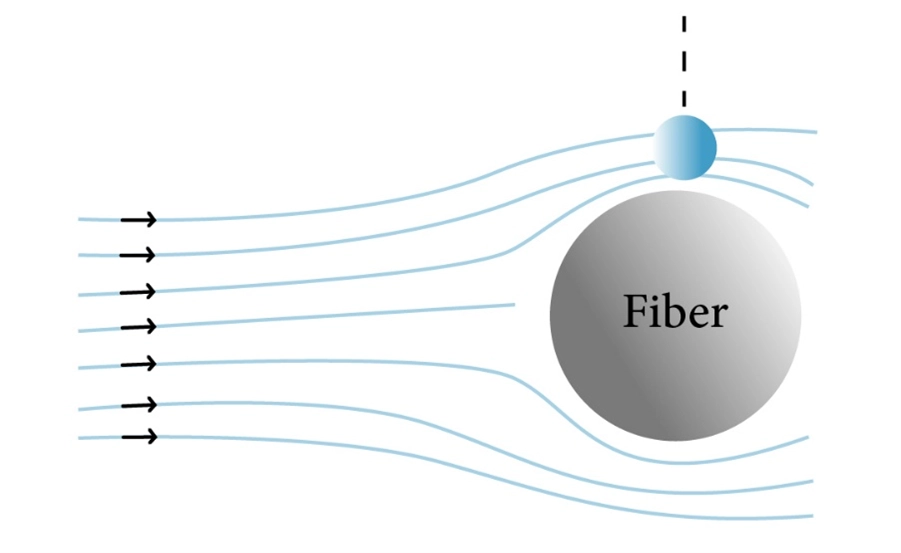
Inertial impaction typically occurs when the airflow changes direction as it passes through the complex pathways of the filter media. Particles with significant mass and velocity—i.e., higher momentum—cannot follow the curving streamlines of the fluid due to their inertia. As a result, they deviate from the airflow path and impact the filter fibers, where they are subsequently captured through molecular attractive forces.
Particles with greater size, density, and velocity exhibit higher inertia and are thus more likely to deviate from streamlines and collide with filter fibers. The velocity of the airflow plays a critical role in the effectiveness of this mechanism. Another influential factor is the density of the fiber network; a denser arrangement increases the likelihood of particle-fiber collisions.
In general, particles around 1 µm or larger are effectively removed by this mechanism. In certain conditions, even particles smaller than the pore size of the media can be captured through inertial impaction.

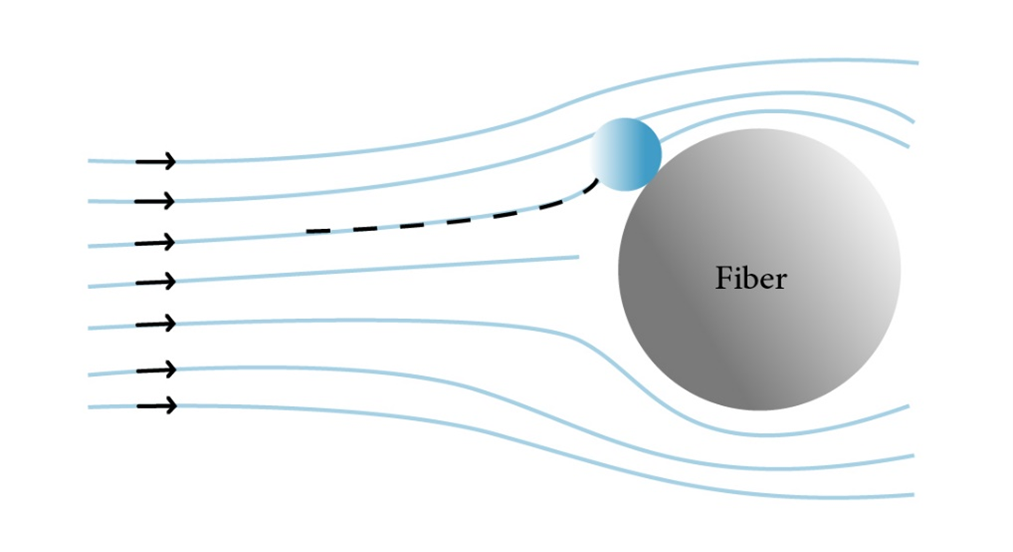
Direct interception occurs when a particle lacks sufficient inertia to deviate from the airflow streamlines but passes close enough to the filter fiber that it comes into physical contact and is captured. In this mechanism, the particle follows the original flow path until it approaches the vicinity of a fiber, at which point natural attractive forces allow the particle to adhere to the filter structure.
Mathematically, interception occurs when the distance between the particle’s center of mass and the fiber surface is less than or equal to the particle’s radius. This mechanism is applicable in both air and liquid filtration and is influenced by the particle’s velocity.
A fundamental distinction between direct interception and inertial impaction is that, in direct interception, particles follow the fluid streamlines without deviation and are captured solely when they come into close proximity with the filter fibers—without requiring sufficient inertia to leave the flow path. This mechanism typically assumes laminar flow conditions and its effectiveness is primarily influenced by the ratio of particle size to fiber spacing, as well as the adhesive interactions between the particles and the filter media.
The diffusion mechanism is the most effective method for capturing particles smaller than 0.2 micrometers. This process is governed by Brownian motion, whereby particles undergo random, erratic movement, significantly increasing the likelihood of collisions with the fibers of the filter media. As a result, extremely fine particles—such as nanoparticles—can be trapped by the filter media, even when their size is smaller than the pore size of the filter.
The effectiveness of diffusion becomes more pronounced as particle size or fluid velocity decreases. At lower airflow velocities, particles spend more time within the filter, thereby increasing the probability of interaction with the fibers through random motion. This leads to a characteristic “Brownian” path of travel for the particles. Because the kinetic energy of these collisions is low, the diffusion mechanism is primarily effective for submicron particles (typically <1 µm), and its influence diminishes as particle size increases. In essence, the smaller the particle, the more significant its random motion—and the higher the capture efficiency.

The electrostatic effect is one of the important mechanisms in air filtration that aids in capturing particles on the filter media. This mechanism plays a particularly significant role in the filtration of ultrafine particles, such as dust and aerosols. In this process, charged particles (positive or negative) are attracted to fibers or media surfaces with an opposite electrical charge.
The electrical charge on either the filter media or the particles can be generated naturally, or as a result of interactions between particles and charged surfaces. In some filters, electrical charges are intentionally induced on the fibers or media to enhance filtration efficiency. This improves the filter’s ability to capture fine particles—even those smaller than the pores—without the need to reduce pore size, thus minimizing pressure drop compared to conventional filters.
When charged particles pass near oppositely charged filter fibers, electrostatic forces cause the particles to be attracted to and retained on the fiber surfaces. The performance of this mechanism depends largely on the charge magnitude of the particles and the media. Airflow velocity also influences the effectiveness of this mechanism; at higher velocities, contact time between particles and the media decreases, which can reduce electrostatic capture efficiency. Therefore, electrostatic filters often perform better at lower flow rates. Figure 6 demonstrates how this mechanism functions.

As previously discussed, various filtration mechanisms contribute to the performance of air filters. The overlap and combination of these mechanisms significantly enhance filtration efficiency, ensuring the capture of particles across a wide range of sizes—from the smallest to the largest. This section elaborates on how these mechanisms interact and their impact on filter performance. To aid understanding, Figure 7 illustrates how different filtration mechanisms operate across varying particle sizes.
According to the figure, each filtration mechanism is most effective within a specific particle size range. However, a critical concept in air filtration is the Most Penetrating Particle Size (MPPS), which refers to the particle size range that is most difficult to capture. Within the MPPS range, airborne pollutants exhibit the highest penetration rates and the lowest filtration efficiency. In other words, filters perform least effectively at the MPPS range but show improved performance for particles smaller or larger than this area.
For this reason, standard filter performance tests typically report filtration efficiency at the MPPS, representing the most stringent operating conditions. The MPPS generally falls between 0.1 µm and 0.4 µm, although this range can vary depending on filter type, design, air velocity, and humidity levels.

Understanding and accounting for the MPPS is critical when designing or selecting air filters, as these particles can easily enter indoor environments and, if inhaled, penetrate deep into the respiratory system. This is especially vital in sensitive settings such as hospitals or in industries requiring ultra-clean air.
The pore size of the filtration media does not directly indicate the minimum particle size that can be captured. Rather, it reflects the likelihood or probability of particle retention. Pore size typically defines the maximum size of particles that can pass through the filter. Smaller particles may or may not be captured depending on several factors, including flow conditions and capture mechanisms.
In some cases, the probability of particle capture may reach 100%, meaning the filter qualifies for an absolute rating at that particle size. In other situations, the capture efficiency may be around 50%, classifying the filter with a nominal rating. Thus, filtration performance is governed not only by pore size but also by fluid dynamics and the active .
In Surface Filtration, particles are collected on the outer surface of the filter media, and separation occurs mechanically. This process—also known as cake filtration—involves the accumulation of particles into a layer or “cake” that contributes to filtration. Needle-punched felts and other media used in baghouse dust collectors operate under this principle. In such systems, cleaning methods such as pulse-jet or reverse flow remove the filter cake and restore media function. In some chemical applications, the cake itself holds value, making its recovery the main objective.
In contrast, Depth Filtration allows particles to penetrate into the fibrous structure of the filter, where they become trapped within the pores or between fibers. This method is well-suited for handling high contaminant loads. It can effectively retain particles even smaller than the pore size due to the various physical interactions inside the filter matrix. The choice between surface and depth filtration depends on the nature and quantity of contaminants, as well as whether the media needs to be washable or reusable.
EN 779 is a European standard used to evaluate and classify air filters in HVAC systems. Based on their efficiency in removing airborne particles, especially fine particulates, filters are categorized into three main groups:
In EN 779, particle size 0.4 µm is used as the reference for measuring filter performance. This selection is based on the particle’s relevance to health concerns and its placement within the MPPS range—where filtration efficiency is at its lowest. These particles are particularly difficult to trap through mechanisms like inertial impaction, interception, and diffusion. Given their ability to reach deep into the lungs, evaluating filter performance at this particle size ensures the strictest assessment. Naturally, filters exhibit higher efficiency at particle sizes above and below this critical range.
This article explored the primary mechanisms of air filtration—inertial impaction, electrostatic attraction, direct interception, diffusion, and gravitational settling—and examined their performance in relation to the MPPS (Most Penetrating Particle Size). Understanding filtration behavior at the MPPS is essential for accurate filter evaluation since this is the region where particles are hardest to capture and where filters exhibit their lowest efficiency.
If a filter performs well in the MPPS range, it will likely be even more effective at capturing both smaller and larger particles. Therefore, in designing high-efficiency air filters, engineers aim to combine multiple filtration mechanisms and select appropriate materials to enhance overall performance.
Modern advancements in air filtration technology—such as the use of ultra-fine and structured fibers, multilayer media, electrostatic charging, nanofiber coatings, and Computational Fluid Dynamics (CFD) simulations—have significantly improved the ability to capture a wide range of particle sizes. These innovations optimize filter performance without sacrificing airflow or causing significant pressure drops.
Author: Forough Khalili

 Save the post
 Projects: