

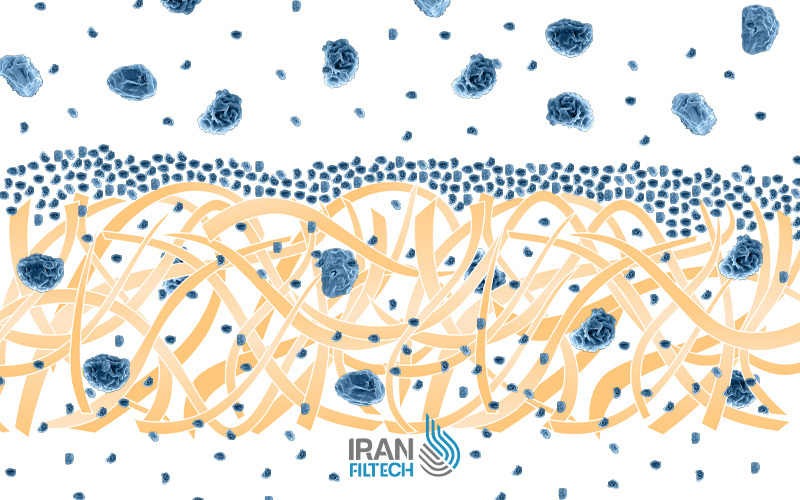
Filtration is a crucial separation process utilized in various industries to remove unwanted materials from fluid streams. There are several ways to perform filters, based on different mechanisms.
- In Mechanical filtration, unwanted materials are removed from the fluid stream based on their size or shape.
- In chemical filtration, impurities are separated from the fluid stream by using chemicals.
- In biological filtration, microorganisms are used to remove unwanted materials from the fluid stream.
In mechanical filtration, particles larger than the filter pores are separated from the fluid stream. Contrary to popular belief, filters can absorb particles smaller than their own pores.
Filters are devices that separate non-uniform particles and impurities from fluids. They work like a sieve that can hold larger particles within its pores and allow smaller particles and fluids to pass through. However, in a real-world scenario, if a layer of larger particles clogs the pores of the sieve, the smaller particles will no longer be able to pass through. Although all the particles are collected behind the sieve, the entire flow is cut off. This means that if we imagine a filter as a sieve, we’ll be faced with a separator with a limited lifespan.
In the engineering and design of the construction of a suitable medium, various parameters are effective, including:
- To produce a medium with high absorption capacity and long life, it’s important to know the type of fluid and contamination, fluid characteristics such as density, viscosity, and surface tension, temperature, flow pressure, volume of contamination, and chemical characteristics of both the fluid and contamination. By considering these specifications, an appropriate medium can be created with proper flow and high absorption capacity.
There are three main mechanisms for absorbing particles smaller than filter pores:
- In Absorption mechanism, particles adhere to the filter surface due to gravitational, van der Waals, or electrostatic forces.
- In the mechanical absorption mechanism, particles are trapped and absorbed by the filter fibers or structural intersections due to friction.
- In Electrostatic absorption mechanism, The particles are absorbed in the filter due to the opposite electrical charges between them and the filter fibers
The amount of absorption of particles smaller than filter pores depends on various factors, including:
- Filter type: Filters are made of different materials and structures that affect the amount of absorption of particles smaller than pores.
- Particle size and shape: Particles that are smaller and rounder are absorbed more easily compared to particles that are larger and irregular in shape.
- Fluid flow rate: The rate of fluid flow has an impact on the number of particles that collide with the filter.
- Filter pressure: The amount of friction between the particles and the filter is impacted by the filter pressure.
Conclusion:
Filters have the ability to trap particles that are smaller than their own pores. This can occur through three main mechanisms: absorption, mechanical absorption and electrostatic absorption. The extent to which particles smaller than filter pores are absorbed depends on several factors such as filter type, particle size and shape, fluid flow rate, and filter pressure.
- “Fundamentals of Filtration”, by John M. Coulson and J.F. Richardson, Butterworth-Heinemann, 2nd Edition, 1999.
- “Filtration Principles and Practices”, by Robert T. Detrick, CRC Press, 1991.
- “Principles of Filtration and Separations”, by Paul A. Schweitzer, Elsevier, 2013.
Author: Mojtaba Saadatpour
September 2023

Save the post